If We Could Go Back In Time - The Persian Empire. Tuesday's Edition
Changing the arc of history. Series 23 #2
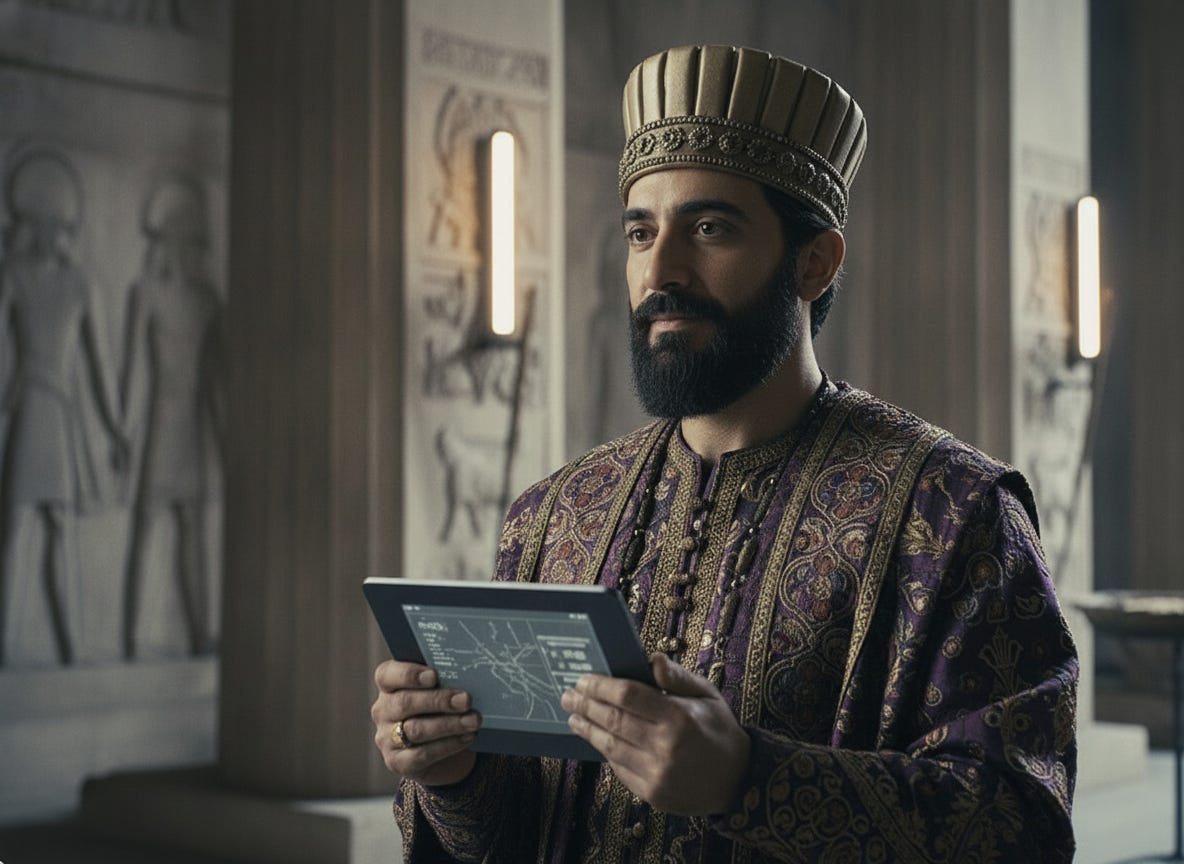
Cyrus the Great built the largest empire the ancient world had yet seen. It reached from Lydia and Ionia in the west through the Levant and Mesopotamia to the Indus in the east, and he ruled this empire by earning the people's respect rather than crushing them.
When Cyrus conquered Babylon in 539 BCE, he allowed the Babylonians to keep their gods, their customs, and their local administrators. He freed the Jewish people from captivity and funded the rebuilding of their temple in Jerusalem. He appointed Persians and foreigners to positions of power based on competence. The Cyrus Cylinder, a clay document recording his tolerant policies, reads, some claim, like a bill of rights. Cyrus adapted the empire’s rules to local conditions rather than forcing the Persian system on everyone it conquered.
The Criteria
The Persian court recruited foreign expertise in medicine, astronomy, and administration as standard practice. Greek physicians, Babylonian scholars, and Jewish administrators all held positions at court.
His government had the power to enforce change, running from the emperor through regional governors who commanded local military and administrative functions. A decision at the top was quickly carried through the entire structure.
The institutions were still being formed, the practices needing change were not deeply entrenched, and his trade routes connected three continents simultaneously, meaning ideas traveled with commerce from the Mediterranean to the Indian subcontinent.
But his reforms did not survive him. The next ruler, Cambyses, his son, reversed the most progressive policies within years of taking power.
The Persian Empire was stable, expanding rather than defending, and capable of absorbing new ideas.
Six of seven criteria score favorably. Succession is the critical weakness. But if those reforms had taken root, the world that follows looks different in concrete ways.
Imagine our time traveler persuades Cyrus to write religious tolerance into imperial law before he dies, and sets up institutions and checks and balances to keep Cyrus’s vision alive. Alexander the Great, who admired Cyrus and kept the Persian administrative system after he conquered Persia, carried that law into Greece, Egypt, and India. Rome, which built its institutions on Greek models, would have inherited a legal system that treats conquered peoples as subjects with rights, not as property or labor. Roman slavery, if it survived into the empire at all, would have been legally constrained from the beginning, defined by debt and status rather than conquest and the permanent categorization of entire peoples as property.
The legal architecture that Spain and Portugal drew on when building their colonial systems in the Americas would also have had different foundations. Plantation labor on the scale that defined the American South and the Caribbean requires one specific legal concept: that a human being can be owned, transferred, and worked to death without recourse. That concept has a traceable lineage. Change the framework at the Roman source, and what follows in the Americas is completely different and more humane
Cyrus got the values right. He just never made them bigger than himself.
If you enjoyed this article, help support my work by becoming a paid subscriber or “buy me a coffee.”


