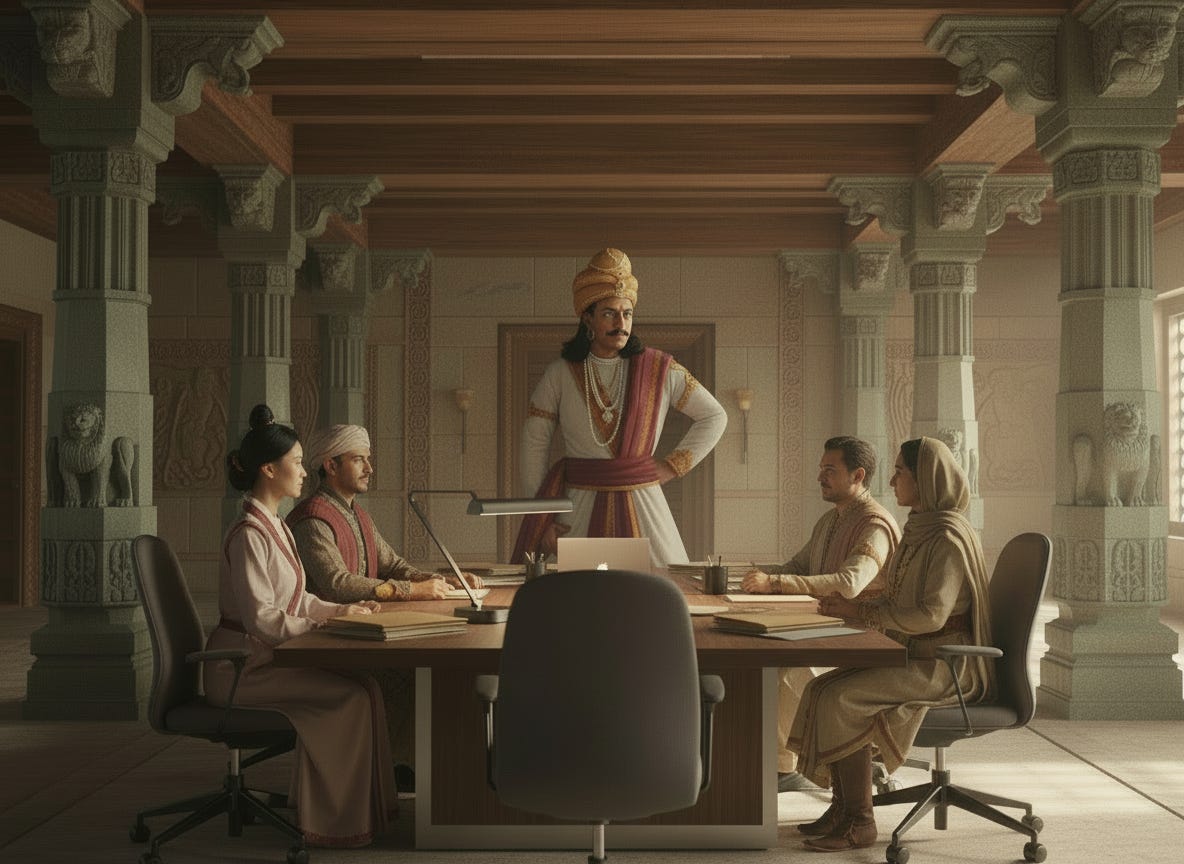
If We Could Go Back In Time - The Maurya Empire. Wednesday Edition
Changing the arc of history. Series 23 #3
Ashoka Maurya inherited one of the largest empires in the ancient world and spent the first years of his reign expanding it by force. In 261 BCE, he sent his army into the Kalinga kingdom, a coastal state in eastern India that had resisted Maurya control, and watched roughly 100,000 people die. What followed was one of the most documented personal transformations in ancient history. He converted to Buddhism, renounced military conquest, and spent the rest of his reign building hospitals and rest houses along trade routes, establishing animal welfare protections, and proclaiming tolerance and non-harm across religious groups. across an empire that stretched from Afghanistan to southern India.
He carved every policy into stone in the local language of each region he governed. He was not writing for court officials. He was writing for ordinary people.
The Criteria
Ashoka received scholars from across Asia, incorporated Buddhist teachings into imperial policy, and dispatched missionaries and envoys to Sri Lanka, Egypt, Greece, and Central Asia. He built imperial law around what he found.
The Maurya system operated through a central government, provincial governors, and local village officials. Decisions made at the top reached ordinary people through the same chain that collected taxes and kept order.
The rules were still being written, some practices were easier to change than others, and Buddhist trade and missionary networks reached Central Asia, Southeast Asia, Sri Lanka, and eventually China and Japan, meaning ideas traveled with commerce and religion across three continents.
But the Maurya Empire broke apart within fifty years of Ashoka’s death. He cut the military so deeply that his successors could not hold the empire together against outside pressure. His reforms were written in stone but never written into law, nor did he build institutions to support them after his death
The empire was stable, internally at peace, and free from existential military threat during his reign.
Six of seven criteria score favorably but succession was a total failure. If those reforms had taken root, the Indian subcontinent would be different in ways that reach into the present day.
Imagine our time traveler persuades Ashoka to write his edicts into permanent imperial law before he dies, and builds institutions strong enough to carry that law through the centuries.
Ashoka’s edicts stated that every person deserves respect regardless of birth or religion, and tolerance and non-harm across religious groups. Written into law and enforced through the administrative chain that reached every village in the empire, that principle confronts the caste system directly. Caste assigned every person a fixed role at birth, determined who could own land, perform which work, enter which temple, and marry whom. An imperial law that says birth does not determine rights does not erase caste overnight, but it gives every subsequent ruler on the subcontinent a legal foundation to challenge it. By the time the Mughal Empire governed India in the sixteenth century, 1,750 years of legal precedent say that birth does not determine a person’s worth.
The religious persecution that defined the conflicts between Hindus, Muslims, and Sikhs during Mughal rule, and that produced the partition of India and Pakistan in 1947, killing between 200,000 and two million people and displacing fifteen million more, could have looked fundamentally different. The 1971 war that separated Bangladesh from Pakistan, killing an estimated 300,000 to three million more, was itself a consequence of a partition that drew borders around religion rather than around people. Nearly two thousand years of legal precedent defining the state's obligation to protect all religious communities do not guarantee that those conflicts would not have happened, but they change how rulers rule and what people expect and demand.
Ashoka got the values right and wrote them in stone for ordinary people to read. He just never made them a permanent part of the government.
If you enjoyed this article, help support my work by becoming a paid subscriber or “buy me a coffee.”


