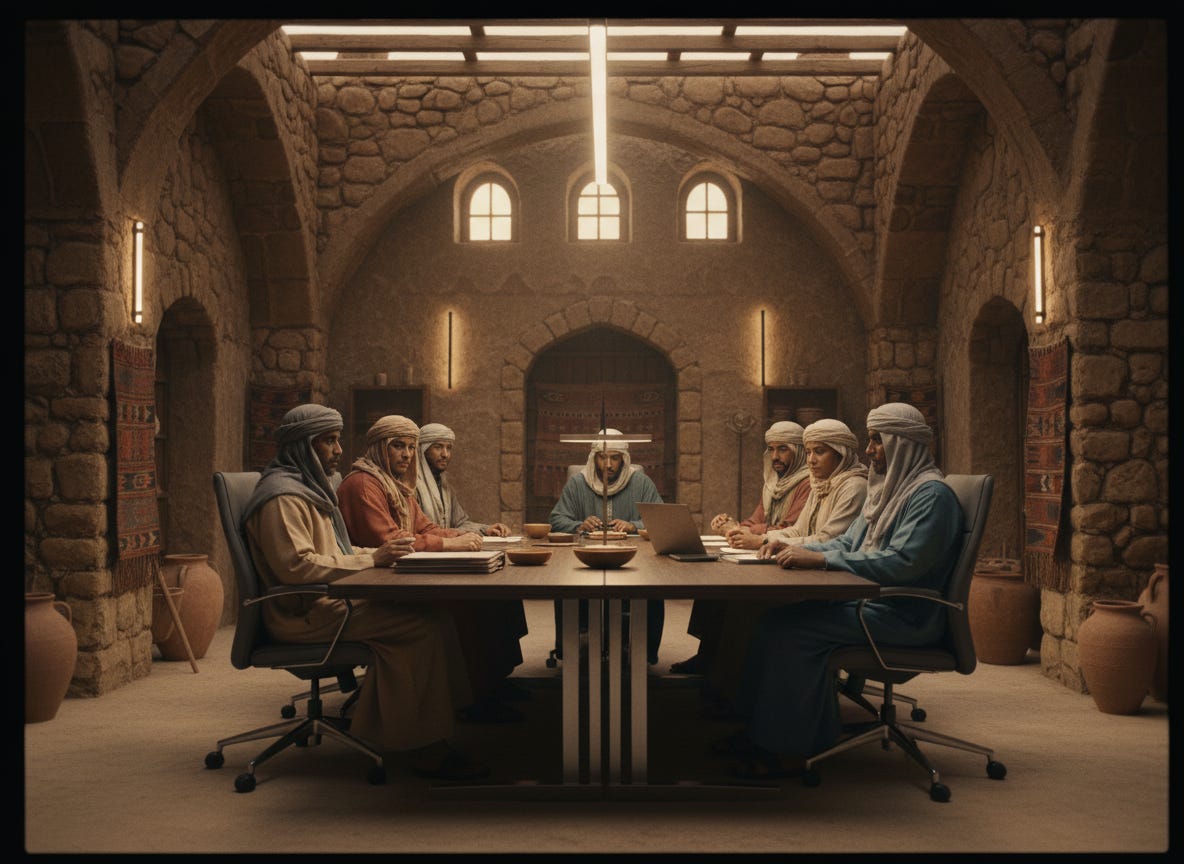
If We Could Go Back In Time - The Early Islamic Caliphate. Friday's Edition
Changing the arc of history. Series 23 #5
The Prophet Muhammad died in 632 CE. Within a century, the faith he founded stretched from Spain to the borders of China. Within two centuries, Arabic was the language of science, mathematics, medicine, and philosophy across three continents. It spread because religion is the most durable transmission mechanism humans have produced. Sacred texts create cultural norms that survive political regimes, cross geographic borders, and survive military defeat. No other religion or empire in history has spread faster, reached further, or embedded its principles more permanently into law, governance, and daily life. That reach, and that durability, is precisely what makes the early Islamic Caliphate the most consequential candidate in this series, and the most dangerous one to intervene in.
Early Islam was genuinely progressive for its time. Women held inheritance and property rights. Christians and Jews had legal rights as People of the Book. Literacy and learning were obligations. Zakat, the obligatory charitable contribution, redistributes wealth to the poor.
The Criteria
The early Muslim community was open to outside knowledge. The hadith, the tradition of seeking knowledge as a religious obligation, states, “seek knowledge even unto China.” This created a genuine desire for outside expertise. The concept of shura, consultation among community leaders, was practiced by the Prophet and accepted early on.
The caliphate had the power to enforce change across an enormous and rapidly expanding territory. The administrative system that developed under the early caliphs reached from Arabia into Persia, the Levant, Egypt, and North Africa within a single generation.
The founding text was still being compiled. The Quran was assembled into its final written form under the third caliph, Uthman, between 644 and 656 CE. The hadith tradition and practices of the Prophet were still being collected and evaluated. This is the longest amount of time in this series to make changes. The norms embedded in the Quran at this time continue to this day. No other candidate in this series has that staying power.
The practices needing change varied in their entrenchment. Women’s rights, while advanced for seventh-century Arabia, fell well short of equality and were codified in religious law in ways that make them difficult to change. Slavery was limited compared to most societies of the time, but it was legally sanctioned. Both practices had roots in the Quran; they were entrenched
Islamic trade networks, military expansion, and the prestige of Arabic scholarship spread across a large part of the world, West Africa, Central Asia, Southeast Asia, the Indian subcontinent, and southern Europe. Any changes would influence a large part of the world.
Reforms embedded in sacred text are genuine and lasting. No political institution can match it. Caliphates die, dynasties rise and fall, but the text and belief remain.
The caliphate was stable and expanding while it was being formed, but the political environment was volatile and dangerous. A misstep trying to make changes is not just a rejection; it’s blasphemy that may come with mortal consequences. This is the only candidate in this series where the intervention could fail catastrophically and make things worse.
All seven criteria score favorably. The risk is how to make a change without being accused of blasphemy and decapitated.
If the time traveler arrives as a scholar already fluent in Arabic, versed in the Quran, and working within the shura tradition, the chances of success increase significantly. If the intervention does not introduce new values but works with what is already being practiced, success is highly likely.
Slavery is the model. The Quran permitted slavery but simultaneously emphasized human dignity, the equality of all believers before God, and the moral virtue of freeing slaves. Early Islamic scholars used exactly those passages to progressively restrict slavery over centuries until abolition became the dominant position across the Islamic world. No one declared the Quran wrong; scholars used its own language and traditions to push for change.
This method could bring change in gender equality and more religious tolerance. The Quran already contains the raw material. Women are described as equal before God. Justice and dignity are foundational obligations. The People of the Book have explicit protections. A scholar working with this argument could eventually bring about full legal equality for women and protections for all religious communities.
Today, 25% of the world identifies as Muslim. Fifty countries have a population that is 50% or more Muslim. In 26 of those nations, across Asia, Africa, the Middle East, and sub-Saharan Africa, Islam is part of the government. Only about 20% of Muslims live in the Arab world. Islam has a global reach.
Taizong’s institutions lasted 250 years, the “empire limit”. The Quran has been in continuous use for 1,400 years. If our time traveler were able to keep his or her head, this is the time and place that could transform the world.
If you enjoyed this article, help support my work by becoming a paid subscriber or “buy me a coffee.”


