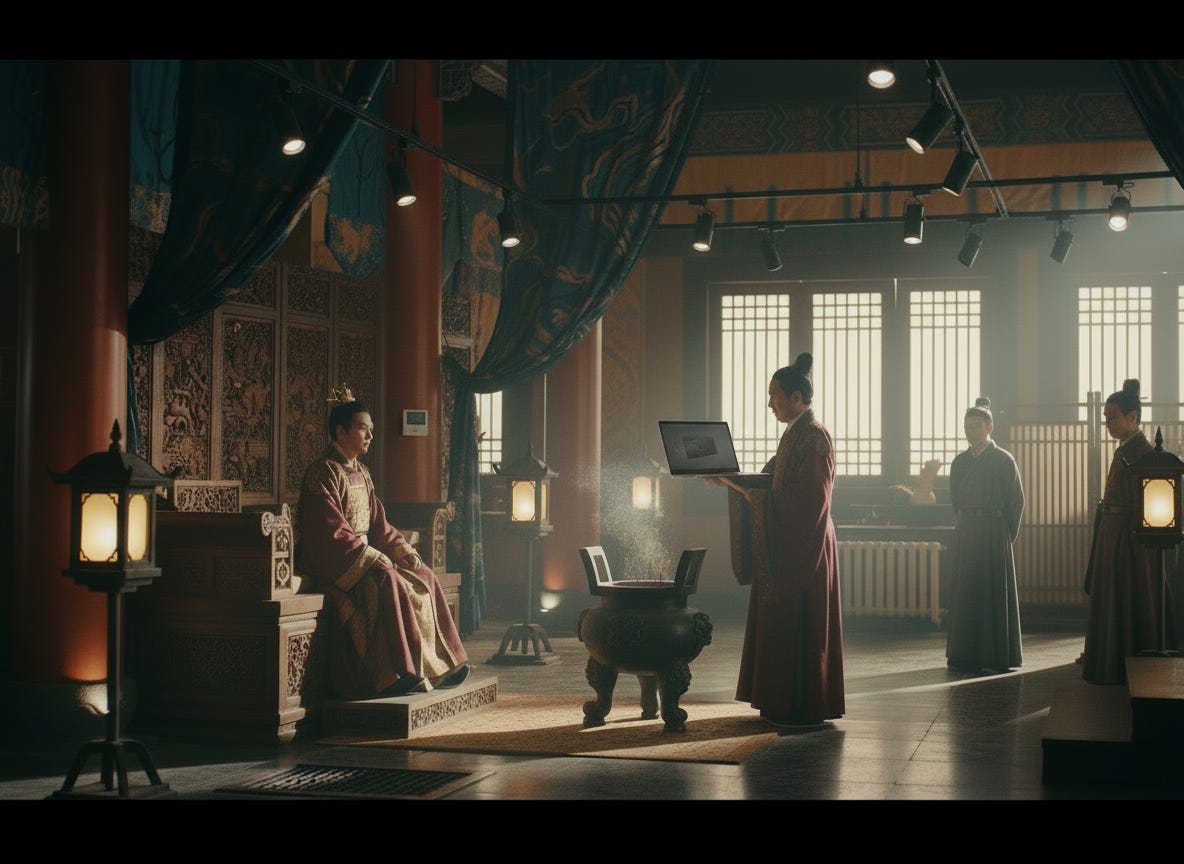
If We Could Go Back In Time - Tang China Under Emperor Taizong. Thursday's Edition
Changing the arc of history. Series 23 #4
In 626 CE, Li Shimin seized the Tang throne, placed his father into comfortable retirement, and began one of the most deliberately self-correcting reigns in history. He took the name Taizong and spent the next twenty-three years building the most cosmopolitan capital city the world had yet seen.
Chang’an, today the city of Xi’an, held roughly one million people. Nestorian Christians, Zoroastrians, Manichaeans, Buddhists, and Muslims all operated openly, built houses of worship, and held positions at the imperial court. Persian refugees fleeing the Arab conquest arrived and received asylum. Korean and Japanese scholars came to study the Tang administrative system and carried it home. The Silk Road ran through Tang China at its peak, connecting Chang’an to Central Asia, Persia, the Byzantine Empire, and the Arab world simultaneously.
The Criteria
Taizong created formal mechanisms for officials to argue against imperial decisions and actively rewarded advisors who contradicted him. A rare practice in any empire in any era. The Tang court drew scholars, merchants, diplomats, and refugees from across Asia, and foreign expertise in medicine, astronomy, religion, and administration flowed continuously through Chang’an.
The Tang Three Departments and Six Ministries system gave the central government direct reach into provinces, military commands, and local administration. Taizong also expanded the imperial examination system. Any man who could pass the examinations could enter state service. Ability mattered more than status.
The institutions were still being consolidated, the Silk Road carried ideas in both directions across three continents, and Tang cultural influence already moved powerfully into Korea, Japan, and Vietnam through direct administrative adoption.
The practices needing change were not equally entrenched. The examination system was already cracking open hereditary privilege. Slavery in Tang China existed, but it was not the economic foundation of the empire. Religious persecution was minimal. Gender exclusion was the most entrenched practice, written into Confucian social structure.
The Tang Empire under Taizong was stable enough to make changes. He had consolidated power after years of civil conflict, managed the northern nomadic threat through a combination of military strength and diplomacy, and presided over a period of internal prosperity that gave the court the capacity to absorb new ideas.
All seven criteria score favorably, and the Tang Dynasty lasted for roughly 250 years, in line with John Glubb's observation that great empires rarely last longer than 250 years. But what would the world look like if it had made it past the 250-year limit?
The examination system, which already reached Korea, Japan, and Vietnam, has time to travel west along the Silk Road into Persia, Baghdad, and Constantinople. Government offices in those cities begin to adopt the meritocracy system. That alone reshapes who governs and how.
The Arab Golden Age, which produced algebra, advanced medicine, and astronomical mapping between 800 and 1200 CE, does not collapse under Mongol invasion in 1258 because institutions built on competence rather than lineage are harder to overthrow. Kill the caliph, and the system continues. Kill the caliph in a purely hereditary system, and the system dies with him.
Europe, which borrowed heavily from Arab scholarship to fuel the Renaissance, inherits a richer, more stable, and more continuous body of knowledge. The Renaissance arrives earlier and builds on deeper foundations. The colonial era that follows it, driven in part by European technological advantage over weakened and fragmented rivals, encounters a Middle East and Central Asia that are neither weakened nor fragmented.
Taizong was on the right track, but history’s time limit brought it to an end. Could knowledge from the future change that?
If you enjoyed this article, help support my work by becoming a paid subscriber or “buy me a coffee.”


