If We Could Go Back In Time - And Change The Arc Of History. Monday's Edition
Changing the arc of history. Series 23 #1
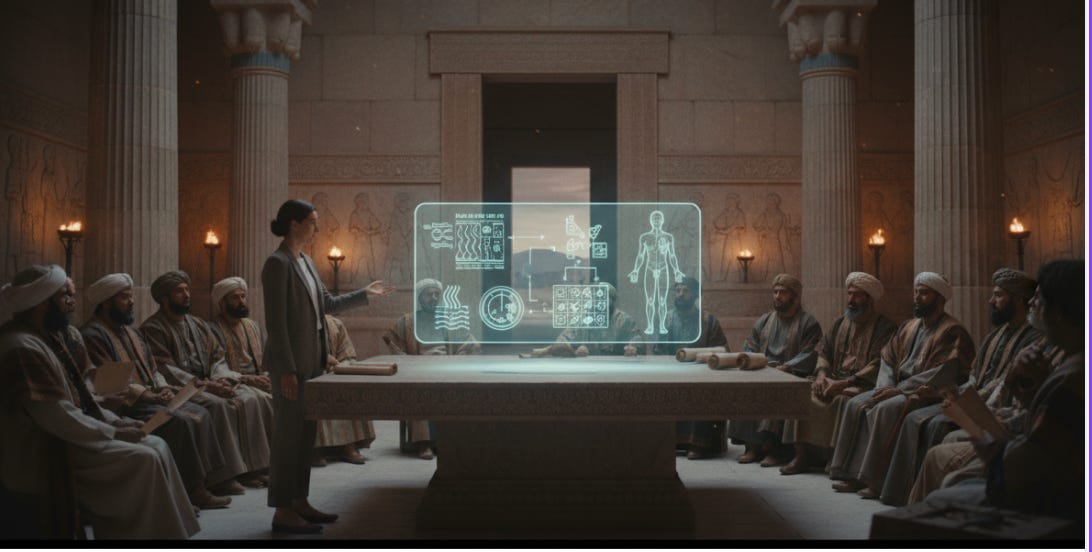
If we could go back in time with the knowledge we have today, medicine, government, agriculture, metallurgy, all aspects of technology, and modern science, which time period and civilization would give us the best chance of changing history? Changing it for the better, to redirect the arc of human history toward peace, inclusion, and less suffering?
This is a thought experiment about cultural conditions. Which societies, at which moments in their formation, are most aligned with what we consider the best form of civilization? Which have the cultural perspective to accept new ideas and institutions? The right ideas delivered to the wrong empire would produce executions, not change.
I gave AI seven criteria and asked it to identify the best candidates:
Will they listen to outsiders? Some rulers actively recruited foreign expertise and rewarded it. Others executed outsiders as threats. An individual or a small group going back in time won’t have much effect; they need a ruler or governing council already disposed to listen and make changes.
Does the government have the power to enforce change? To make lasting change, the government must have the power to enforce new laws and customs and influence the population. A single power center where change at the top changes law, administration, military command, and culture is needed. Changing the course of history would be much easier by changing the Roman government than by changing each Greek city-state.
Are the institutions still being formed? An empire already locked into its economic structure, power hierarchies, and social expectations resists change at its foundations. An empire in its founding generation, where institutions are still being written, can be more easily changed.
How deeply rooted are the practices needing change? How deeply is a practice built into the economy, the law, and the daily lives of the people you are trying to change? Slavery embedded in mass agricultural production is entrenched in how the economy runs and who holds power. Slavery in courts and administrative roles is easier to dismantle.
Can the ideas spread beyond this civilization? Reforming a geographically isolated society helps only that society. The target civilization must sit on trade routes, run religious networks, or possess sufficient military and cultural power for the changes to spread to other societies.
Will the reforms survive the next ruler? Change must be written into law, built into government institutions, and anchored in religious or philosophical frameworks; it must eventually change the culture so that it becomes permanent.
Is the civilization stable enough to focus on something other than survival? Is it secure enough to accept and implement new ideas without an immediate threat requiring its attention and resources?
Tuesday through Friday’s Editions examine the four candidates AI came up with. They cover the Middle East, India, and China, but interestingly, AI did not include any Western civilizations. Each represents a different combination of strengths and weaknesses. Each offers a distinct cultural perspective on how civilizational change actually happens, and why it so often fails.
Saturday’s Core Brief synthesizes the analysis into a recommendation and examines what the comparison reveals about the conditions that make lasting progress possible.
If you enjoyed this article, help support my work by becoming a paid subscriber or “buy me a coffee.”


