How The Big Three Power's Currencies Work. The Yuan And The Ruble. Wednesday's Edition
The Long Chain: The Dollar, The Yuan, And The Ruble. Series 37 #2
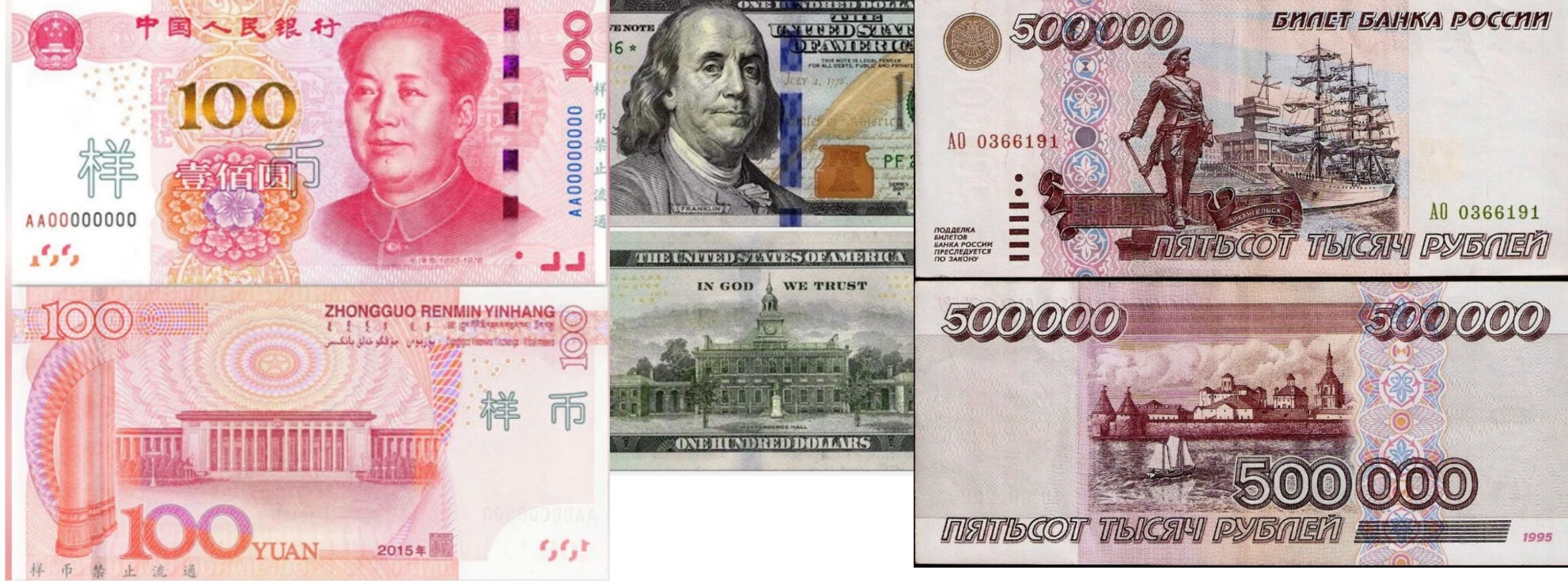
Monday’s Edition showed that the dollar is the world’s most-used currency because money moves freely and American courts enforce contracts equally regardless of who is involved. The Chinese yuan and the Russian ruble are built differently. In both countries, the government keeps tight control of the currency and limits how money moves in and out. That control is why neither currency can replace the dollar, and it stems from a different cultural perspective in each country.
The biggest differences with the Chinese yuan are that:
It does not float. Each morning the People’s Bank of China, the country’s central bank, sets a reference price for the yuan against the dollar and allows it to trade only within 2 percent of that price.
The bank is not independent. It is an arm of the Chinese state and follows the Communist Party’s directives, and the Party can change those directives at any time.
Money also cannot move freely across China’s border. A person or company must get permission to send large amounts in or out, a system called capital controls.
Because of those controls, there are two versions of the yuan: the onshore yuan used inside China, which the state manages closely, and the offshore yuan, traded in Hong Kong and a few other cities, which moves more freely but makes up only a small share of all the yuan in use.
Some nations use the yuan to trade but few to save. In the first quarter of 2026, the yuan made up about 2 percent of the world’s reserves, compared to the dollar’s 57 percent. In June 2026, the yuan handled about 3 percent of payments sent through SWIFT, the messaging system banks use to move money across borders. China clears yuan payments through its own network, CIPS, launched in 2015. Payments cleared through CIPS are not included in that 3 percent.
This level of control fits the Chinese cultural perspective. Geert Hofstede, a Dutch researcher who measured how national cultures differ, ranked China high on Power Distance, which means people accept that authority is concentrated at the top and expect the state to direct national life. In that view, the government setting the exchange rate and controlling the flow of money is normal and expected. The cultural theorist Shalom Schwartz adds a second trait: China ranks high on Embeddedness, in which the person and the private market are treated as parts of the group and are expected to support the state priorities rather than act on their own. Thus, the state, not the market, sets the value of the yuan. Hofstede also ranked China high on Long-term Orientation, the habit of working toward goals over decades or a century. China increased the yuan slowly, accepting a small share of world trade now to build more trade later. The one thing it will not do is let money move freely, because that would let money leave the country and reduce the state's control. Restricting the flow of money in and out of China is why the yuan can pay for trade but cannot yet hold the world's savings.
Russia also controls its currency but for a different reason. The ruble is restricted in reaction to Western sanctions. On paper, the ruble floats, but in practice, since 2022 the Russian state has kept it from failing with limits on moving money out of the country, interest rates far above inflation, and, until 2025, a requirement that exporters convert their foreign earnings into rubles. When the United States and Europe cut most large Russian banks off from the dollar and from the SWIFT financial messaging network in 2022, the ruble crashed. It recovered, under Moscow’s controls. By the middle of 2026, the ruble had gained about 10 percent against the dollar and traded near 80 rubles to the dollar (before 2014 the ruble traded around 30 to 35 per dollar).
The ruble is not freely convertible. A foreign investor cannot count on moving money out of Russia, and Western sanctions block most large ruble trading abroad. So the ruble is used almost entirely for Russia’s own trade and inside its own borders, and almost no country holds it as a reserve. What gives the ruble value is oil and gas. As long as other countries buy Russian energy, foreign money flows in, and the state limits how much money can leave the country and keeps interest rates above the rate of inflation to keep the ruble from losing value.
This defensive design fits Russia’s cultural perspective. The political scientists Ronald Inglehart and Christian Welzel measured a scale from survival values to self-expression values, and placed Russia far toward Survival. In a survival culture, people value safety, order, and a strong government more than openness and personal freedom, and that preference grows stronger when they feel threatened. Placing controls on the currency to survive sanctions is how Survival cultures operate. Schwartz would add that Russia also scores high on Embeddedness, the value placed on stability and the existing order. Russia gave up the free movement of money to keep the ruble viable while under sanctions, but no one outside Russia has a reason to hold it.
The dollar moves freely, and the world holds it. The yuan is controlled by a patient government and used mostly to buy Chinese goods. The ruble is controlled by a state under siege and used mostly inside Russia. China gave up open money flows for control to protect its slow, decades-long rise as an economic power. Russia traded it for control to survive. Both got their control, and both gave up the one feature that makes a currency attractive to hold.
Friday’s Edition looks at how these three currencies act on each other: where the dollar, the yuan, and the ruble compete, where they depend on each other, and whether the dollar’s slow decline in reserves points to something larger.
If you enjoyed this article, help support my work by becoming a paid subscriber or “Buy me a coffee.”
Get a solid understanding of Trompenaars’ cultural dimensions by purchasing the guide or subscribing to Cultural Perspective (free or paid) and receiving the guide for free.


