How Did America Get Trump? The Generation That Split The Country. Monday’s Edition.
The Long Chain: American Populism. Series 30 #1
On June 3, 2026, President Donald Trump signed an order stripping job protections from about 8,000 federal workers, making them far easier to fire. It was one of many executive orders. Trump signed 143 executive orders in his first hundred days, more than any president before him in that window. By the middle of 2026, Trump had signed more than 250 executive orders, raised tariffs on imported goods, tightened immigration enforcement, and begun remaking the government’s workforce. He had returned to office in January 2025 after winning the November 2024 election with 312 electoral votes and 49.8 percent of the popular vote. America has chosen right-wing populism, and it now governs the United States.
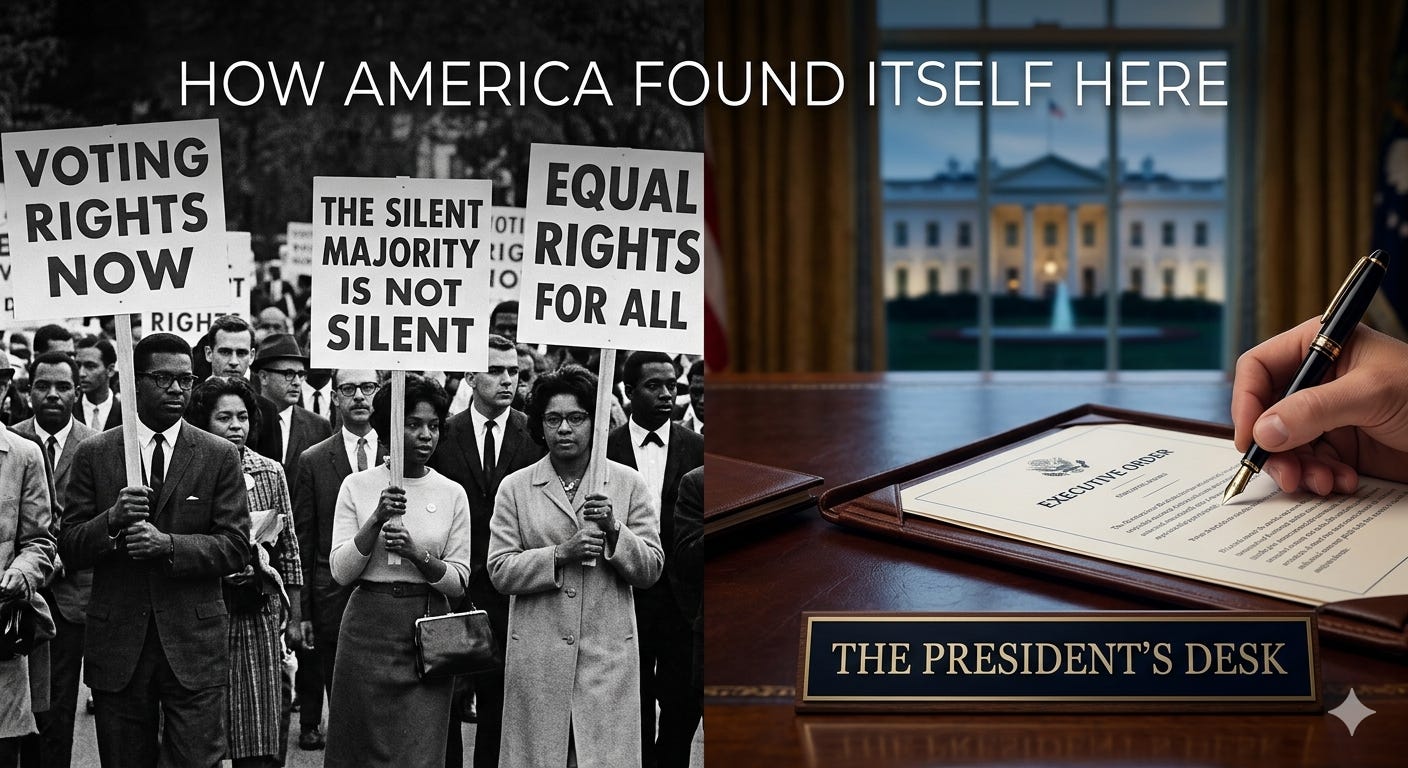
How did America find itself in here? The reason runs back more than sixty years, when the groundwork was laid for a fight between two groups of Americans whose cultural perspectives diverged over time.
It started with money. The generation raised during the postwar boom were the first American generation to grow up without scarcity. That security caused a change in their priorities. Political scientist Ronald Inglehart called this the silent revolution: people raised in a safe environment no longer need to focus on survival. This allows them to move to the next level, prioritizing self-expression, freedom, and personal identity. Inglehart and Christian Welzel later traced the same shift across many countries, away from Survival Values and toward Self-Expression Values.
That change in values caused the great movements of the 1960s and 1970s: the civil rights movement, second-wave feminism, the sexual revolution, and a steady move away from religion. Each of the new Self-Expression values in turn displaced the older values about faith, family, and order that most Americans had taken for granted. That displacement resulted in the first organized reaction.
Older, more religious, less-educated Americans felt the country they were raised to defend was slipping away, and in 1969, President Richard Nixon gave them a name, the “silent majority.” These two groups align well with cultural theorist Schwartz's Autonomy, where people are expected to question, debate, and form their own ideas, and Embeddeness, where people's identity comes from family, community, tradition, and the role one is born into. Pippa Norris and Ronald Inglehart called it the cultural backlash, and it is the prime driver of this whole story. Some scholars argue the engine is economic, not cultural, that lost jobs and stagnant wages drove the same voters, but Diana Mutz tested both and found that fear of losing status best explained the populist vote. Economics is the secondary driver.
A second reaction was also taking place. The 1964 Civil Rights Act banned segregation in public accommodations and employment discrimination, and this caused white Southern voters, who had voted Democratic for nearly a century, to leave the Democratic Party. Nixon’s 1972 campaign captured them with what became known as the Southern Strategy: appeals on crime, law and order, and welfare that spoke to racial fear without naming race. That strategy made the Republican Party the home of racism and fused it with the cultural backlash already forming. From this point, the two reactions, one over changing values and one over ending racism, run together as a single force.
The racism issue intensified with the 1965 Hart-Celler Act, which ended the racial quotas that had kept immigration overwhelmingly European. This resulted in immigration shifting toward Latin America, Asia, and Africa, which caused the US to move toward a future in which white Americans would no longer be the majority. That shift made traditional Americans (Embeddedness) feel even more fearful of losing what they thought America should be. Diana Mutz calls this fear status threat: the dominant group’s reaction to losing its place as the nation changes.
The progress intensified with the Supreme Court’s 1973 Roe v. Wade decision legalizing abortion and the fight over the Equal Rights Amendment. These issues and others caused religious conservatives to fear that the new values now had the force of law behind them and America had fundamentally changed. That conviction led the preacher Jerry Falwell to found the Moral Majority in 1979, which organized religious traditionalists into the Republican Party and turned a loose cultural grievance into a voting bloc the Party could count on.
This is the cultural perspective the whole series rests on. The populist right is the reaction of Embedded Americans, raised on tradition and wanting life to stay the same, to Autonomy Americans who value personal choice, equality, and freedom. Neither of these groups are making free, independent choices. They are acting the way their cultural programming requires them because values are stable within an individual, but they doe shift across generations
A postwar boom raised a generation that valued self-expression over survival, which drove the movements of the 1960s, which displaced the old moral consensus, which produced the first traditionalist backlash. The Civil Rights Act drove the white South out of the Democratic Party, which the Southern Strategy captured and fused with that backlash. Hart-Celler then moved the country toward a white minority, which deepened the sense of lost status, and the Moral Majority turned all of it into a voting bloc. Sixty years later, that bloc governs.
Wednesday’s edition traces how this same cultural perspective became an election machine: the anti-government ideology Ronald Reagan gave it, the talk radio and cable networks built to feed it, the political style that turned compromise into betrayal, and the collapse of the unions that once held the white working class on the left.
If you enjoyed this article, help support my work by becoming a paid subscriber or “Buy me a coffee.”
Get a solid understanding of Trompenaars’ cultural dimensions by purchasing the guide or subscribing to Cultural Perspective (free or paid) and receiving the guide for free.


