How Did America Get Trump? How The Machine Was Built. Wednesday’s Edition.
The Long Chain: American Populism. Series 30 #2
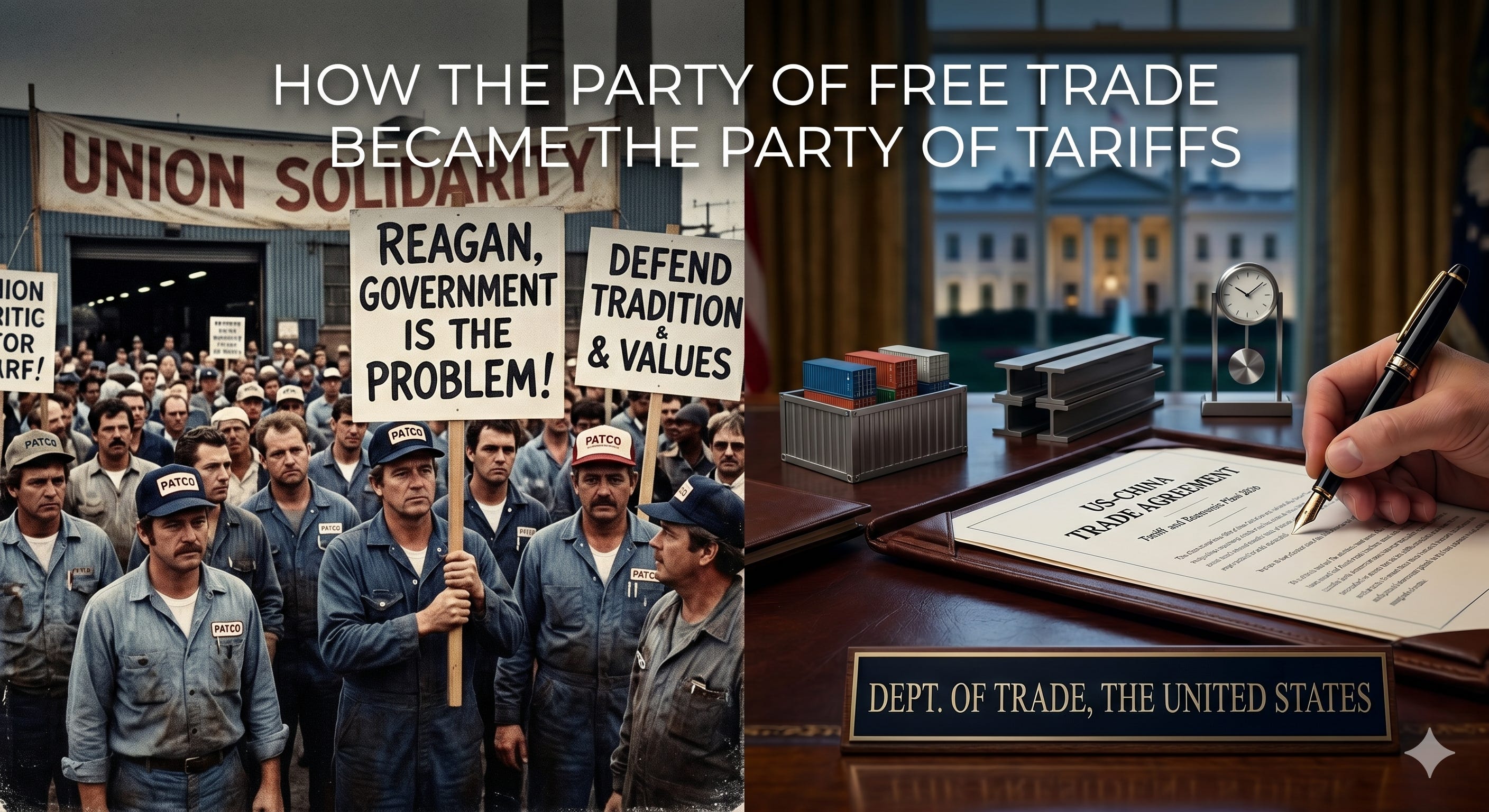
On June 11, 2026, the Trump administration announced a new trade agreement with China. It kept tariffs on Chinese goods at about 30 percent and paused a set of higher tariffs for sixty days. The announcement was routine by now. Trump had spent sixteen months using tariffs as his main economic tool, taxing imports from most of the country’s trading partners. A Republican president was running the economy on trade barriers, a policy the party’s own leaders had fought against for thirty years.
How did the party of free trade become the party of tariffs? The answer is the same chain that put right-wing populism in power, traced one stretch further. Monday’s edition ended in 1979, when the preacher Jerry Falwell’s Moral Majority handed the Republican Party a reliable bloc of religious voters. That bloc had grievances and numbers. What it did not yet have was a program, an outlet, and a leader.
That bloc helped elect Ronald Reagan in 1980. Reagan gave the backlash something it had lacked, a single enemy. In his 1981 inaugural address, he said, “Government is not the solution to our problem; government is the problem.” That sentence turned the government itself into the thing standing between traditional, Embedded Americans and the country they wanted. This fused the cultural backlash with a war on government. The message took hold because of America’s hyper Individualism. Cultural theorist Geert Hofstede found the United States the most individualist country he studied, a culture that treats self-reliance as a virtue and government help with suspicion and as a moral weakness. Reagan’s line told that cultural perspective exactly what it believed.
In August 1981, he fired more than 11,000 air traffic controllers who had gone on strike and banned them from federal jobs for life. It was a clear signal that corporations could go after the unions and shut them down. That, together with the closing of American factories, collapsed union membership from about a third of workers in the 1950s to roughly one in ten.
Unions had organized the white working class around the same goals: higher pay, steady jobs, and good benefits. Their collapse changed what those workers voted on. They started voting on their religion, race, and way of life rather than their paycheck. The anger over lost jobs and falling wages no longer pushed them toward the left, which blames employers and the wealthy. It pushed them toward the right, which blames immigrants and government.
China's entry into the World Trade Organization in 2001 caused a flood of cheap Chinese goods, which wiped out factory jobs across specific American towns. What economists later named the China shock. The lost work discredited the leaders of both parties who had promised that open trade would make everyone richer. It pushed the hardest-hit places to elect angrier, extreme politicians. By now, the base of the movement was set: millions of workers stripped of their unions, their factories, and their trust in the government.
A change in broadcasting law gave them a voice. The Federal Communications Commission repealed the Fairness Doctrine in 1987, the rule that had required stations to give both sides of an issue airtime. That repeal created the false impression that a given, usually extreme, view was correct because no counterargument was required. A radio host named Rush Limbaugh went on stations across the country in 1988 and by the 1990s reached about 20 million listeners. His success built a one-sided conservative media that Fox News extended to cable television in 1996, which fed a mass audience one party's extremism.
That one-sided media rewarded conflict and sidelined compromise, and that gave the advantage to politicians who treated the other party as enemies to be destroyed. Newt Gingrich coached fellow Republicans, in a 1990 memo, to describe Democrats with words like "sick," "traitors," and "corrupt," and with that approach, took control of the House of Representatives in 1994. He forced a government shutdown in 1995 rather than make a deal. That refusal to compromise became the new Republican standard. Political scientists Thomas Mann and Norman Ornstein identify this as the source of the win-at-all-costs politics that would lead to Trump’s election.
By 2001, this was a political machine. From Reagan, it had a target and a plan: government was the enemy, and shrinking it was the goal. It had the white working class, stripped of its unions and its jobs, and ready to vote on religion, race, and way of life. It had a media feeding those workers one party's skewed and extreme account of events, and politics that treated compromise as collaboration with the enemy. All of this organized the anger the 1960s had produced, when the country's values changed, and segregation ended (Monday’s Edition).
All that was needed was the right person to bring it all together.
Friday’s Edition traces how the 2008 financial crash and the election of the first Black president brought Donald Trump into the Oval Office, and where the U.S. is headed next: the prediction for the 2026 midterms and what comes after.
If you enjoyed this article, help support my work by becoming a paid subscriber or “Buy me a coffee.”
Get a solid understanding of Trompenaars’ cultural dimensions by purchasing the guide or subscribing to Cultural Perspective (free or paid) and receiving the guide for free.


