

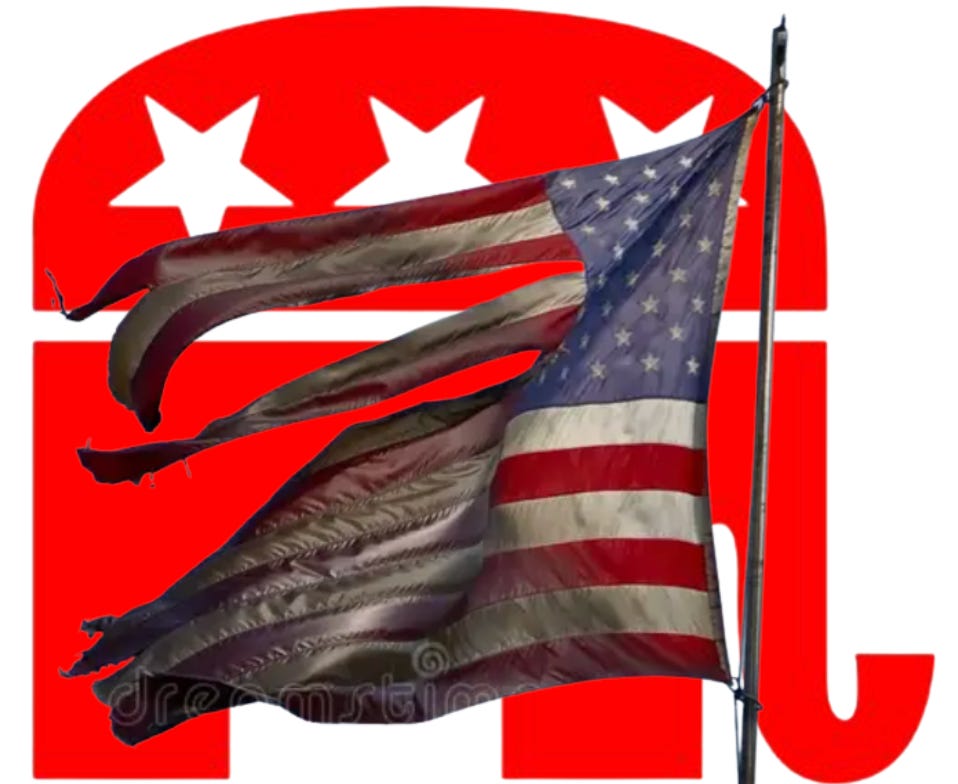
We all know that Trump promised to make America richer, stronger, and more powerful. We also know his policies have been a disaster. But how bad are they? How badly have Trump and the Republicans damaged the U.S.
Tariffs. Trump’s tariffs have bankrupted American businesses, permanently eliminated jobs, and driven foreign customers to other suppliers. Many businesses will never reopen; it will take years for jobs to return, and some foreign customers will never buy American products again, even if future presidents eliminate every tariff.
The most damaging part: long-term trade agreements among nations that purposely exclude the U.S.
Immigration. Trump’s deportations have driven workers out of American farms, construction sites, and other businesses, causing labor shortages, lost production, and higher prices. Crops left unharvested are lost forever, homes delayed cannot meet today’s housing needs, and businesses that close because they cannot find workers may never reopen.
The most damaging part: the Republicans have shown that immigrants who are legally protected, following all the rules, and even those eligible for citizenship can be arrested, imprisoned, and deported - immigrants have no legal protection, and immigration may never return to the levels needed to keep America running.
Government agencies. Trump eliminated over a quarter million federal jobs across 22 major agencies, eliminating years of experience and weakening government services. Future presidents can hire new workers, but they cannot restore the years of lost knowledge, delayed research, and public services Americans needed but never received.
The most damaging part: people die.
War with Iran. Trump’s war has depleted American weapons stockpiles, damaged military assets, and weakened America’s ability to fight other wars.
The most damaging part: It has shown the world that Trump or any future president can start a war on a whim, and the government and military will support and fund it even when the U.S. is clearly the aggressor.
Foreign relations. Trump has damaged America’s standing with allies and trading partners, weakening trust built over 80 years. Countries such as Canada are now expanding trade with other nations and reducing their dependence on the United States.
The most damaging part: The U.S. is being replaced in international institutions and BRICS and other coalitions are permanently taking market share and weakening the dollar.
These Trump disasters reinforce one another.
Tariffs raise prices and force businesses to close
Deportations create labor shortages and raise prices, which in turn forces more businesses to close.
Fewer government services reduce efficiency, resulting in less help for the ever-growing population of those in need.
Tariffs, deportations, war, and botched foreign relations isolate the U.S., reducing its power, influence, and economic strength, reinforcing America’s domestic disasters.
This shift reflects Trump and the Republicans moving the U.S. government from Long-Term Orientation to Short-Term Orientation (Geert Hofstede).
Long-Term Orientation focuses on the future and produces benefits for decades. Short-Term Orientation focuses on tradition and quick results, even if it means a worse future.
For 80 years, America built its wealth and power through long-term interests in trade, alliances, and institutions. Trump and the Republicans have thrown that away for short-term political gain and personal wealth.
They have also changed the government from moderate Motivation Towards Achievement and Success (Geert Hofstede) to the extreme. This dimension concerns how much a culture values success, results, and competition, compared with care for others and quality of life.
American culture has always valued competition, achievement, material success, and individual ambition, yet its leaders understood that nations could compete and still benefit from cooperation.
Under the Trump-Republican regime, trade and diplomacy are treated as contests, and there can be only one winner. It is no longer a ‘rising tide lifts all ships’; it is now “I win, and you lose.”
This cultual shift in government focus results in isolation and a loss of power militarily, diplomatically, and economically, and in increasing poverty for the nation. This is not easily or quickly reversible.
The problem is that a future president can:
remove a tariff but not change a trade agreement between other nations that purposely bypassed the U.S.
replace federal employees, but not restore decades of institutional experience overnight.
promise allies that America will honor its word, but not immediately build trust that takes decades.
None of this proves that American decline is permanent. Better decisions could repair some of the damage, but while Trump’s policies can be reversed, their consequences cannot.
This week we will examine what those choices cost Americans, how they affect American power, and what the country could look like in the next few years.
If you enjoyed this article, help support my work by becoming a paid subscriber or “Buy me a coffee.”
Get a solid understanding of Trompenaars’ cultural dimensions by purchasing the guide or subscribing to Cultural Perspective (free or paid) and receiving the guide for free.

When our PM Mark Carney spoke recently to a pro- Canada rally in advance of today’s referendum in Alberta (including a question on separating from canada) , the biggest cheers were for “decreasing our dependence on USA”. Then there was a giggle on “they’re touch down there. We’re not. We’re getting on with things. “
Tells you all you need to know. Americans should prepare for a world without USA at the centre. Which may not be a bad world, without you carrying the burden of exceptionalism.