How America Lost Its Power. Weaponizing The Dollar. Wednesday’s Edition.
The Long Chain: American Power. Series 31 #2
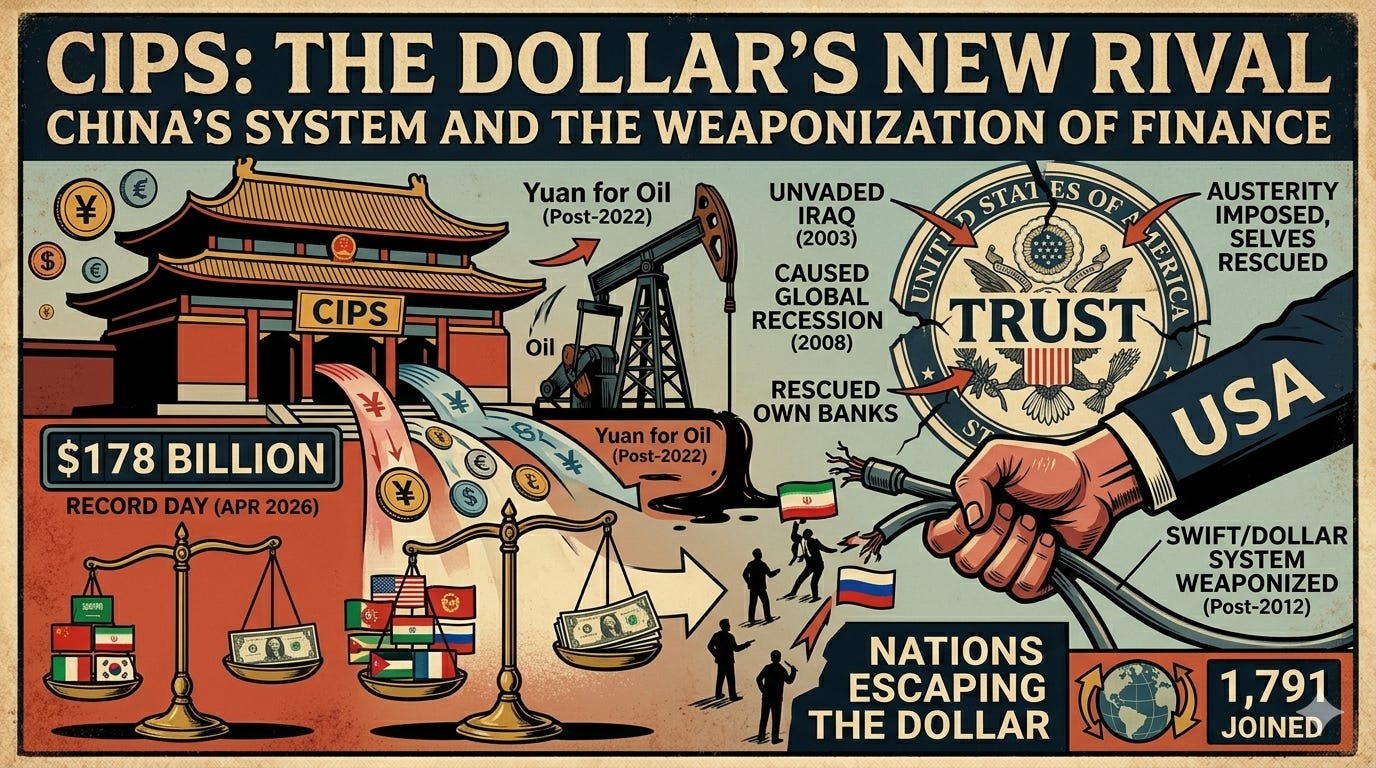
In April 2026, a payment system most people have never heard of set a record. China’s CIPS, its own network for moving money between banks across borders, pushed a record $178 billion through in a single day. By early 2026, 1,791 banks and financial firms worldwide had joined it. Its busiest days came as conflict in the Middle East pushed oil buyers to pay in Chinese yuan rather than dollars. CIPS exists for one reason: to let countries trade without using the American banking system.
Countries built CIPS to escape the dollar.
Monday’s Edition traced how American power was built on the dollar and how, after 1971, that power changed from trust to need and force. By the mid-1970s, the dollar was the currency most international trade was priced and settled in, and that dollar payments ultimately clear through US banks. This gave America the power to cut any country out of the global financial system.
America’s power still largely rested on the trust that it would follow its own rules. In 2003, it openly broke that trust. It invaded Iraq, but the United Nations Security Council would not authorize the war. America invaded anyway. The UN’s own secretary-general, Kofi Annan, later said the war broke the UN Charter. The nation that wrote the rules openly and deliberately broke them
At the same time, the dollar’s status as the global reserve currency was creating a disaster at home. In 1997, the financial crisis hit Asia, and the IMF, the global lender that America controls. The US forced those countries to cut spending, raise interest rates, and let their banks fail. To ensure they would never have to borrow from the IMF on those terms again, their central banks bought hundreds of billions of dollars in US government bonds and, seeking higher returns, bundles of American home loans. Trillions of dollars flowed back into the United States.
That influx of money pushed American interest rates down
Shortly after the Asian financial crisis, the US government relaxed rules for its own banks. After the Great Depression, America passed the Glass-Steagall Act in 1933, a law that made it illegal for a single company (a bank) to hold people's savings and engage in financial market trading. A bank could not risk ordinary people's money in the markets. In 1999, the government repealed that law. The US government also chose not to regulate derivatives. A derivative is a contract whose value comes from something else, such as a stock price, an interest rate, or whether a borrower repays a loan. This allowed banks to profit or lose huge sums depending on whether people kept up their mortgage payments. These changes allowed banks to take far greater risks, which caused a housing bubble.
That bubble burst in 2008. Because the banks had sold those loans worldwide, the collapse spread to every country that had invested in them. The American model that the world had copied dragged the whole world into a recession. Then America did the opposite of what it had ordered Asia to do in 1997. Instead of letting US banks fail, the government rescued them. America forced austerity on other countries but rescued itself.
This erosion of trust convinced China and other nations that it could not rely on the dollar. In March 2009, the head of China’s central bank, Zhou Xiaochuan, called for a new global reserve currency composed of multiple currencies. This way, no single nation could control it. This is what British economist John Maynard Keynes argued for at the 1944 Bretton Woods conference. The US rejected this in favor of using the dollar. China began the long work of building its own network to move money without the dollar.
China’s new system grew slowly because, after the 2008 crisis, there was no urgency to abandon the dollar. That was until America turned the dollar system into an actual weapon. The first strike hit Iran: in 2012, America and Europe cut Iran’s banks out of SWIFT, the messaging network that lets banks move money across borders. It was the first time a country had been shut out of the world’s financial system, and Iran’s trade was severely disrupted. The next hit was Russia, which was sanctioned in 2014 for seizing Crimea. The message was clear: access to the global financial system was controlled by the US, and it would decide who could and could not use it. Mark Carney named this at Davos in 2026, when he counted “financial infrastructure as coercion” among the new weapons of great powers.
America controlled the world’s money because the world trusted it to play by the rules. Then the US broke its own rules in Iraq and later caused a global recession, from which it rescued only itself. This pushed China and other nations to find an alternative to the dollar. Then, the US used the dollar as a weapon against Iran and Russia. Each step made more nations want out of the dollar system. This caused systems like CIPS to grow, further weakening the dollar. But the strongest evidence that the dollar was no longer safe was to come.
Friday’s Edition covers the day America froze another country’s reserves, the moment slow drift turned into open flight, and what the chain says happens next.
If you enjoyed this article, help support my work by becoming a paid subscriber or “Buy me a coffee.”
Get a solid understanding of Trompenaars’ cultural dimensions by purchasing the guide or subscribing to Cultural Perspective (free or paid) and receiving the guide for free.


