

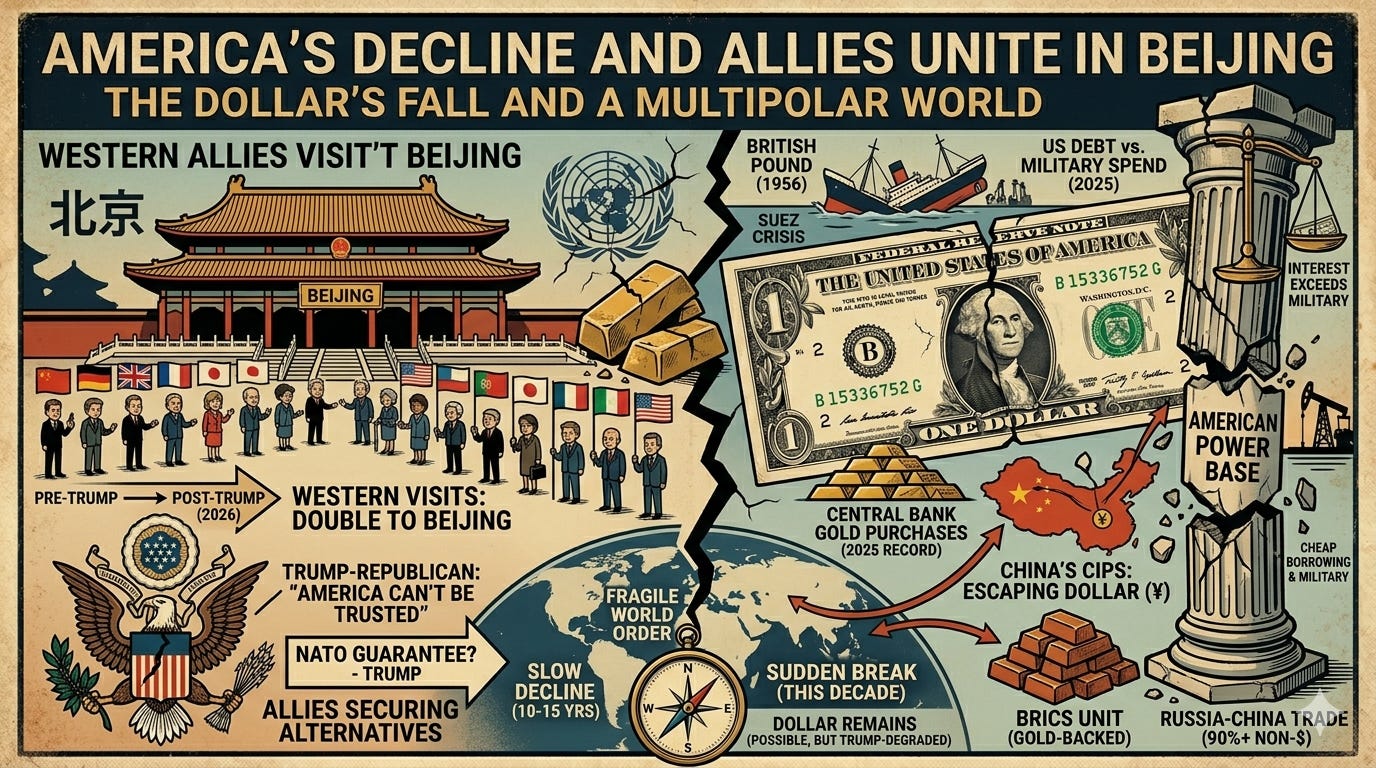
In the spring of 2026, the leaders of America’s closest allies were making trips to Beijing. In the thirteen months after Trump took office, the heads of twelve Western governments traveled to China. Western officials now make about half of all the senior visits to Beijing, twice the number of trips before Trump took office. These are countries that have depended on American protection since World War II.
They are building ties with China because they no longer trust the US.
Monday’s and Wednesday’s Editions traced how American power came from trust in the dollar, and how America broke that trust by ending the gold standard in 1971, invading Iraq in 2003, crashing the world economy in 2008, and cutting Iran and Russia out of the dollar system in 2012 and 2014.
Then, in 2022, after Russia invaded Ukraine, America and its allies froze about $300 billion of Russia’s national savings, the money its central bank had stored in Western nations. Blocking a country’s ability to pay was one thing; freezing its money was another. This had been done before, but in much smaller amounts and smaller nations, Iran in 1979, Libya in 2011, and Afghanistan in 2021. Thus, freezing the assets of a major power sent a clear message: no nation’s money held in dollars or in any Western currency is safe from being frozen if America decides to do so.
A central bank cannot take that risk. So central banks began buying gold and switching to systems like China’s CIPS to move money without the dollar.
Then America went crazy. The Trump-Republican administration that took office in 2025 put taxes on imports (tariffs) from its own allies, raising America’s average tax on imports to about 27 percent, the highest since the Great Depression. America’s own Supreme Court ruled the main tariffs illegal in 2026. The Trump-Republican administration threatened to take Greenland from Denmark, a NATO ally. Trump made it clear he would not guarantee American commitments to NATO. He moved to take control of America’s central bank, whose independence is what keeps the dollar trustworthy. For eighty years, America had claimed to follow the rules while sometimes exempting itself in practice. This was not ideal, but it was tolerated because it worked. Then the Trump-Republican administration made it clear: the US would no longer participate in the global system it had established. Trump's instability and erratic actions made the system unworkable. Trump’s “America First” meant “America Can’t Be Trusted.”
That is why America’s allies are in Beijing. They watched America break its promises and then break down. They had to protect themselves. The numbers show it. The dollar has fallen to about 57 percent of the world’s reserves, its lowest share since 1995. Russia and China now settle more than 90 percent of their trade without the dollar. BRICS, which accounts for about 40 percent of the world’s output, measured by purchasing power parity, is testing a gold-backed trade system called the Unit, though Brazil and India have rejected a single BRICS currency.
The dollar is the foundation of American power. Because the world holds dollars, America can borrow more cheaply than any other country, and that cheap borrowing paid for the most powerful military on earth and the bases and alliances that come with it. That advantage is rapidly shrinking. In 2025, America spent more on interest on its debt than on its military for the first time. As the world holds fewer dollars, America must pay more to borrow, leaving less for the military and weakening the protection it offers allies, giving those allies one more reason to leave. The dollar built American power, and losing the dollar takes the rest down with it.
The dollar will not collapse overnight. In 1920, the dollar overtook the British pound sterling, yet the pound stayed a top reserve currency for decades, propped up by Britain’s empire and inertia. What finally brought it to an end was debt and a single event. In 1956, when Britain invaded Egypt to seize the Suez Canal, the United States threatened to sell its pounds unless Britain retreated. Britain, unable to defend its currency, backed down. A reserve currency falls when two things line up. The issuing country has accumulated too much debt, and then one crisis sends it over the edge.
What will happen to the US dollar? Three things can happen from here.
