How America Lost Its Power. From Trust To Force. Monday’s Edition.
The Long Chain: American Power. Series 31 #1
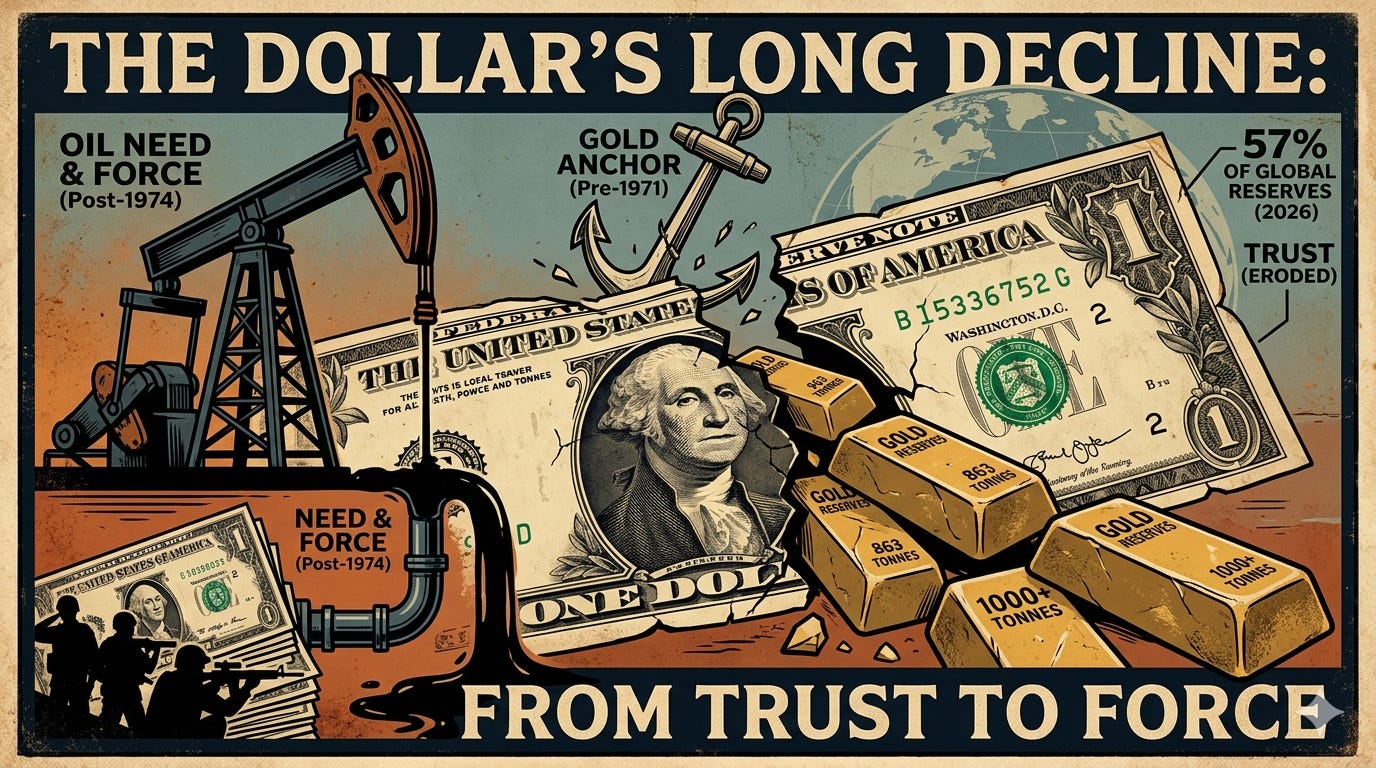
By early 2026, the dollar had fallen to about 57% of the world’s currency reserves, from a high of 85% in 1977 and its lowest share since 1995. Central banks that manage a nation’s money were buying more gold in place of dollars. Central bankers added 863 tonnes of gold to their reserves in 2025, and more than a thousand tonnes in each of the three years before. That is the biggest run of gold since just after World War II. The people who guard their nations' savings are moving away from the dollar.
The dollar is what gives the U.S. its power.
America emerged from the Second World War holding about half of the world’s output and most of the world’s gold. In July 1944, at a meeting in Bretton Woods, New Hampshire, America wrote that dominant position into rules other nations agreed to follow. The dollar was fixed to gold, and the world’s other currencies were fixed to the dollar. This made the dollar the center of world trade. Those rules made American dominance long-lasting because the world trusted the U.S. to follow them.
Trust, not military power or gold, was the foundation of American power and what led other nations to accept American leadership, hold its dollars, and live by its rules.
But that trust had a contradiction. America built a global order with one set of rules for all nations, universalism. America, though, acted from the opposite cultural perspective, particularism. It believed it was special and did not have to follow its own rules. Americans didn’t call it particularism; they called it American exceptionalism. This is what Mark Carney, in his famous speech at Davos, called the "pleasant fiction" from which "the strongest would exempt themselves when convenient."
The American world order also carried a fatal flaw. The U.S. promised to back each dollar with an equivalent amount of gold at a price of $35 an ounce. Because the world held the dollar as its main reserve currency, the money nations keep for safety and trade, America sent more dollars to nations than it held in gold reserves. Economist Robert Triffin warned in 1960 that the system forced America ever deeper into debt to the rest of the world, and that debt would eventually cause the U.S. to break the promise to swap dollars for gold.
That flaw was a trap, and it turns out America sprang the trap on itself. The U.S. had set itself as the protector against communism, a policy called containment. To contain communism in Asia, it sent its military into Vietnam. Paying for that war while also funding large social programs at home, “guns and butter” required far more dollars than the U.S. had in gold.
That widening gap between dollars and gold led foreign governments to demand gold rather than dollars. Nations began sending dollars back to America in exchange for gold. That run on American gold forced President Nixon to end the dollar-gold exchange. On 15 August 1971, Nixon ended it without warning. American allies were blindsided when America broke the system's central promise.
That broken promise left the dollar backed by nothing but trust, trust that had been eroded by breaking the promise. This caused the dollar to lose value through the 1970s. The falling dollar had an oversized negative impact on oil-producing countries because they were paid in dollars that bought less with each transaction. That loss in value and the 1973 Arab Israel War pushed the oil states to cut supply and raise the price of oil 300 percent. This caused the worst inflation America had seen since the war.
Inflation and the falling dollar forced America to find a new anchor for its currency, now that gold was no longer possible. America reached an understanding with Saudi Arabia in 1974. In an arrangement kept secret until 2016, the Saudis agreed to invest their oil earnings in US government debt, and in return, America supplied military aid, equipment, and security backing for the ruling family. Oil was already sold in dollars, and the Saudis kept it that way. This meant that virtually any country that wanted to buy oil needed dollars to pay for it
That arrangement changed how American power worked. Before 1971, the world held dollars because America promised to back them with gold. After 1974, the world held dollars because America controlled the oil trade and protected the states that sold it. The foundation shifted from trust to need, from a promise kept by the U.S. to dependence on the U.S., held in place by force. And because the whole world now needed dollars to buy oil and to trade, much of the world’s money had to move through American banks, which handed America even greater power: the power to cut off any country from the global financial system.
Wednesday’s Edition covers what America did with this new power: how it turned the dollar system into a weapon, and the day its own model broke the world.
If you enjoyed this article, help support my work by becoming a paid subscriber or “Buy me a coffee.”
Get a solid understanding of Trompenaars’ cultural dimensions by purchasing the guide or subscribing to Cultural Perspective (free or paid) and receiving the guide for free.


