

Governments make policies that either support profit for corporations and the rich or opportunity and success for people.
When a government writes a law, it decides who comes first. The US government tends to put companies first. The Chinese government tends to put ordinary people first. Here is what that difference looks like:
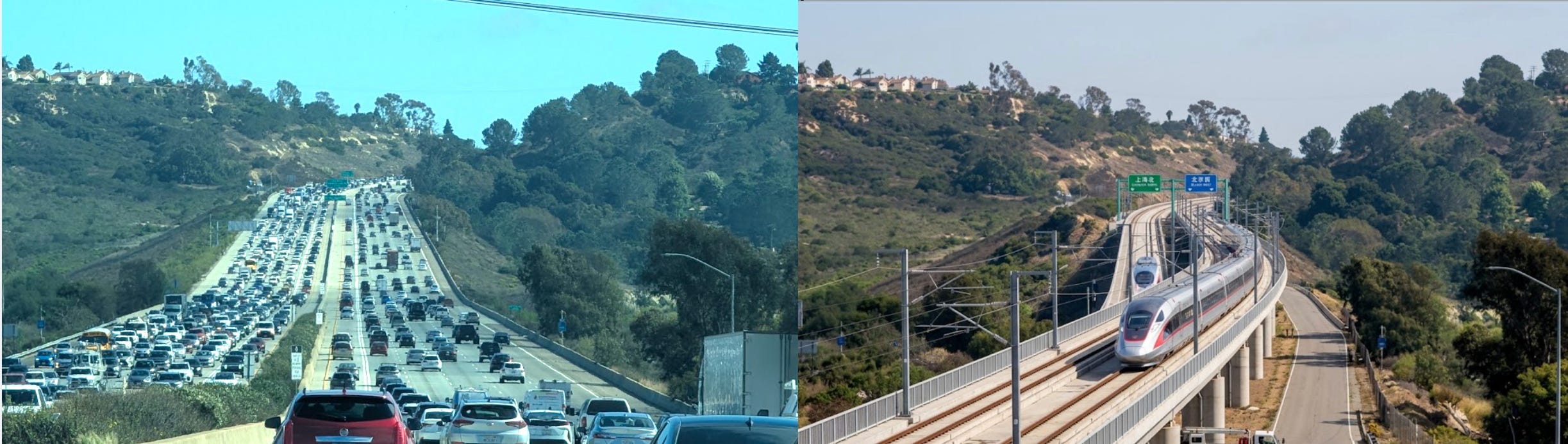
1. Transportation. In 1982, Congress raised the federal gas tax and assigned 80% of the new money to highways and 20% to public transit (Eno Center for Transportation). The highway money paid road builders and expanded the market for cars, car parts, car maintenance, and most importantly, oil companies. Sixty-six percent of oil goes to vehicles (EIA, "Use of oil”).
China took a different route and built 50,400 km of high-speed rail (China Daily). China has highways also but the US has no dedicated high-speed line (Fast Company).
2. Drug prices. A U.S. 2003 law barred Medicare from negotiating the prices of the drugs it covers under Part D (KFF).
Since 2018, China’s national government has bought generic drugs in bulk. By the end of 2022, prices on 294 drugs had fallen by about 50% on average (Frontiers in Pharmacology).
3. Health insurance. In the U.S., health insurance and many hospitals are run to be as profitable as possible. As a result, Americans pay an average of $15,474 per person (CMS; Home Health Care News). Costs are so high that about 45,000 Americans die every year because they can not afford health insurance (Harvard Gazette).
At the end of 2025, China’s basic medical insurance covered 1.33 billion people, about 95% of the population (State Council of China).
4. Taxes. The 2017 US tax law cut the corporate tax rate from 35% to 21% with no end date (Tax Policy Center). This increased the profit margin for corporations and the wealthiest individuals.
In 2018, China raised the monthly income at which workers begin paying income tax from 3,500 yuan to 5,000 yuan (China Daily). The change cut government revenue by about 320 billion yuan a year but helped China's poorest.
5. Education. In the 2025 to 2026 school year, tuition at US public four-year universities averaged $11,950 a year in tuition and fees and $45,000 at nonprofit universities (College Board). In June 2024, Americans owed $1.65 trillion in student loans (Federal Reserve Bank of New York). In fiscal year 2025, 21 US universities each held endowments worth more than $10 billion. Harvard's endowment reached $55.67 billion, and Yale's reached $44.15 billion (Forbes).
In fall 2023, Shanghai raised public university tuition for the first time in more than 20 years. After the increase, students pay $913 to $1,039 (The China Project). In July 2021, China ordered tutoring companies for core school subjects to become nonprofits. It also banned them from raising money on stock markets (WilmerHale).
6. Minimum wage. The US federal minimum wage has stayed at $7.25 an hour since 24 July 2009. No other period since the minimum wage began in 1938 has lasted this long without a raise (NPR). Low wages mean larger bottom lines for companies.
A 2004 Chinese regulation requires provincial governments to increase their minimum wages at least once every two years (CECC).
7. Rural internet. From 2015 to 2020, the Federal Communications Commission paid AT&T, Frontier, and CenturyLink more than $7.3 billion to bring broadband to rural homes. After the payments ended, AT&T served only 31.5% of the addresses it had reported as covered (Broadband Breakfast).
By the end of 2021, more than 99% of China’s villages had both fiber and 4G service (Yicai Global).
No government chooses only profit or only people. The US government pays for Medicare and Social Security. China’s basic insurance leaves patients paying a large part of their medical bills themselves. The difference is which side each government favors when the two conflict.
Culture also decides what “good for the people” means. US culture puts the individual first: Individualism (Hofstede). Americans define a good life as the freedom to choose, compete, and earn. US lawmakers act on this belief when they assign transit, medicine, and broadband to private companies.
Chinese culture puts the group first: Collectivism (Hofstede). For more than 2,000 years, Confucian teaching has held rulers responsible for the people's welfare. In the fourth century BC, the philosopher Mencius wrote: “The people are the most important, the state comes second, and the ruler is least.” Chinese leaders act on this belief when they order drug prices down and build rail lines across the country.
Culture narrows their options. Understanding the cultural drivers helps explain the why and the what’s next.
Americans are at the breaking point of making sacrifices and paying for corporate profit, and helping the rich get richer. I am optimistic this will change. The change may happen as soon as the midterm elections on 3 November; it may take another decade, but it will happen.
If you enjoyed this article, help support my work by becoming a paid subscriber or “Buy me a coffee.”
Get a solid understanding of Trompenaars’ cultural dimensions by purchasing the guide or subscribing to Cultural Perspective (free or paid) and receiving the guide for free.
