

The world is undergoing a transformation. You know this but this transformation is different because it will fundamentally change how nations relate to one another.
To understand what comes next, we need to understand how we got here.
Throughout history, powerful nations have influenced others in three ways.
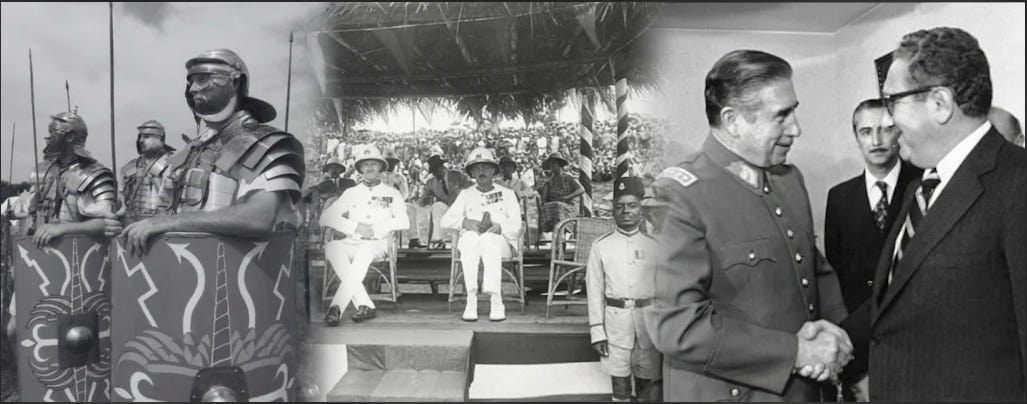
Conquest. Powerful states acquired territory by attacking, invading, and conquering other states. The empire absorbed the conquered state. Possessing land, people, resources, and armies formed the foundations of power.
Colonialism. Imperial powers controlled distant territories, extracting resources, directing economic activity, and exercising political authority. The imperial power controlled the colonies, but the colonies had fewer political rights, and institutions functioned to serve imperial interests. (United Nations)
Alliances. Powerful states exercised influence through military commitments, economic relationships, institutions, and negotiated arrangements. The superpower influenced the allied state but did not govern it. (NATO)
These systems overlapped throughout history, but the arc of history and power has moved toward greater political autonomy and cooperation. (United Nations)
Absorption → Control → Influence
World War II demonstrated the importance of alliances. The Allied powers coordinated their military and economic resources to defeat Germany and Japan.
After the war, alliances became central to the international order. The United States emerged as the central power in a network of security alliances, international institutions, and economic relationships. That system shaped international relations for more than seventy years. (NATO)
Now the system is changing.
Three developments are particularly important.
Economic relationships are diversifying. Nations are reducing dependence on dominant economic powers and creating trade blocs of smaller powers, none of which dominate. (IMF; ASEAN)
Security relationships are being reassessed. Governments are shifting from dependence on a powerful ally to relationships among middle powers to protect their interests without relying on a dominant power. (Council of the EU)
The international system is becoming fragmented. The United States is reducing its influence in international institutions. (White House) China is expanding its involvement. Developing nations and middle powers are taking greater roles, and these institutions are less dominated by the superpowers (United Nations)
While the outcome will benefit the world, the transition will be turbulent.
According to the Stockholm International Peace Research Institute, global military spending reached $2.887 trillion in 2025, the eleventh consecutive annual increase. (SIPRI)
The World Trade Organization’s March 2026 report identified renewed fragmentation in international trade, driven largely by increasing tensions between the United States and China. (WTO)
These developments are temporary. They do not indicate where geopolitics is headed; rather, they reflect a chaotic transition period as nations move along the arc of history toward greater political autonomy and cooperation.
We are witnessing the breakdown of one international order, making way for the next, as the page of history turns. But this is more than a page change; this is a new chapter in the book. This transformation changes the underlying nature of power itself, from rivalry and domination to interdependence.
My working hypothesis is that cooperative interdependence will replace rivalry as the principal organizing mechanism of global order.
Nations will not stop competing, but they will realize that competition and cooperation, without underlying control, influence, or coercion, yield far greater benefits.
What comes after empires, colonies, and alliances?
That’s what we’ll explore this week.
If you enjoyed this article, help support my work by becoming a paid subscriber or “Buy me a coffee.”
Get a solid understanding of Trompenaars’ cultural dimensions by purchasing the guide or subscribing to Cultural Perspective (free or paid) and receiving the guide for free.

What’s coming is corporate states.
I agree that best case is mutual alliances. Supported by long term developmental Models, the need to contain corporatism run amok and to address global issues that transverse borders: climate, data, finance. Humanity growing up?