Culture - The Force That Directs How We Show Our Feelings. Wednesday’s Edition
The force is within us. Series 19 #3
When something makes you truly happy, do you shout it from the rooftops or smile to yourself and tell a few people later?
You’re in a meeting, and a colleague takes credit for your idea. Your chest tightens, your jaw sets. Do you say something? Do you let your face show it? Or do you keep your expression neutral, wait for the meeting to end, and address it privately because showing frustration in front of others would be unprofessional?
Or, a client calls to say your team just won a major contract. Do you pump your fist, shout the news across the office, and hug the person next to you? Or do you smile, say “that’s great news,” and send a composed email to the team?
Most people think their answer comes down to temperament. “I’m just not expressive,” or “I wear my heart on my sleeve.” But the emotions you’re allowed to show in public, and how intensely you’re allowed to show them, are predetermined by your culture.
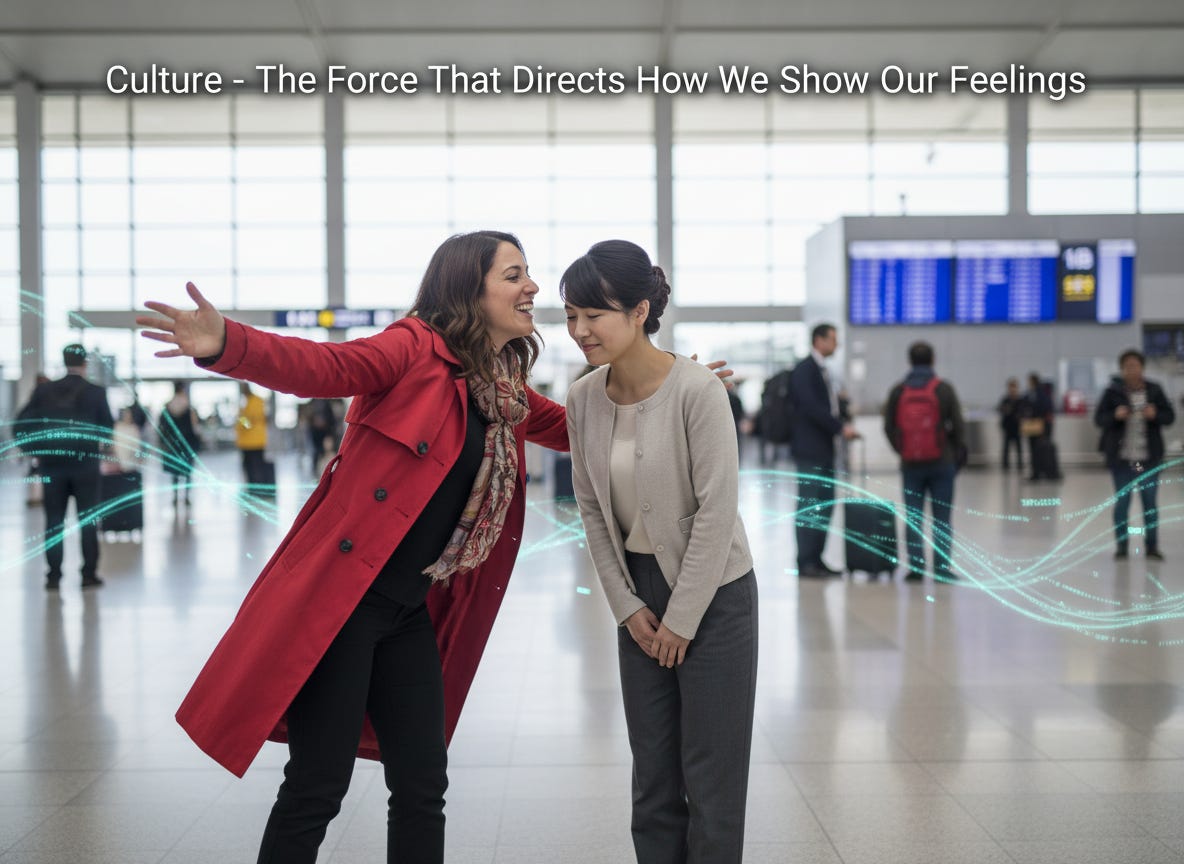
For example, two old friends who have not seen each other in years meet at the airport:
The Italian woman in Rome spots her friend at arrivals, shouts her name across the terminal, runs to her, grabs her shoulders, kisses both cheeks, and holds her face in her hands while telling her she looks wonderful. Other passengers glance over and smile. No one is surprised. She is crying a little and laughing at the same time because this is what joy looks like when you haven’t seen someone you love in years.
The Japanese woman in Tokyo spots her friend at arrivals, walks toward her at a steady pace, bows, and says it is very good to see you again. She smiles warmly. Her voice is soft. She suggests they get tea and catch up. She is feeling the same intensity of emotion as the Italian woman, but her cultural software processes it differently. Displaying that feeling publicly would burden others with her emotions, draw unwanted attention, and violate the cultural norms she has followed since childhood.
Same reunion. Same depth of feeling. Completely different cultural permission to show it.
Researcher Fons Trompenaars called this the neutral versus affective dimension. In affective cultures like Italy, Spain, Mexico, and much of Latin America, emotions are an accepted and common part of communication. Expressing what you feel is authenticity, builds connection, and shows you care enough to be open and vulnerable. Holding back reads as cold, disengaged, or untrustworthy. In neutral cultures like Japan, the United Kingdom, the Netherlands, and Germany, emotions are private. Controlling what you display signals maturity, respect for others, and professional competence. Expressing too much reads as unstable, undisciplined, or manipulative.
This plays out in every business interaction. A Mexican negotiator raises his voice, gestures broadly, and tells his Dutch counterpart that this deal matters deeply to his company. He means it as a commitment. The Dutch negotiator hears theatrics, wonders what’s being hidden behind the performance, and trusts the Mexican less, not more. The Mexican reads the Dutchman’s calm as indifference and wonders why he bothered flying to Amsterdam if the deal isn’t that important.
Both people are expressing satisfaction and trust, and both are misreading it.
Hofstede’s indulgence versus restraint dimension reinforces this pattern at a broader level. Indulgent cultures permit the free pursuit of pleasure, happiness, and emotional expression. Restrained cultures regulate desire through social norms and duty. Mexico scores 97 on indulgence. Japan scores 42. Why the Italian cries and hugs at the airport, and the Japanese woman bows, comes from something deeper than manners. Some cultures teach you to let feelings out, and others teach you to hold them in. That cultural programming starts in childhood and lasts a lifetime.
Your cultural perspective determines what you’re allowed to feel, how much of it you can show, and whether showing it makes you trustworthy or suspicious.
Thursday’s Edition examines how cultures organize time and status, and why showing up early with the right answer still gets you nowhere if you break rules you didn’t know existed.
Sidebar:
Neutral vs. Affective (Trompenaars): Whether a culture programs people to control emotional expression in public settings or to express emotions openly as a form of authentic communication.
Indulgence vs. Restraint (Hofstede): Whether a culture permits the free pursuit of enjoyment and emotional expression or regulates desire through strict social norms and a sense of duty.
If you enjoyed this article, help support my work by becoming a paid subscriber or “buying me a coffee.”


