Culture Shapes Behavior, But What Shapes Culture? Monday's Editon
How culture originated
Stand at the edge of a rice paddy in southern China, Bengal, West Africa, or the Mekong Delta. The field is flooded it also connected. Irrigation channels connect it to neighboring paddies. If one farmer drains water at the wrong time, the surrounding crops fail. Planting and harvesting require coordinated labor across many families. Individual disputes over water can starve the village. Cooperation is not a convenience here. It is a requirement for survival.
Now, stand in a wheat field in northern China, Germany, Iraq, or southern Russia. The farmer plants seeds, waits for rain, and harvests when ready. His survival depends on the weather, not the neighbors. He can succeed or fail independently. If he argues with the farmer next door, both still eat.
The same basic need to grow food, but radically different social requirements.
This observation sits at the center of a question that matters far more than academic curiosity: culture shapes how people think, work, govern, and negotiate. But what shapes culture in the first place?
It is not history and tradition. Germans are individualist because of their history. Japanese are collectivist because of theirs. This answer is circular. It describes, but it does not explain.
A better approach asks what material conditions produce particular cultural patterns. Not what a culture believes, but why it came to believe it. Not what norms exist, but what made those norms the norms.
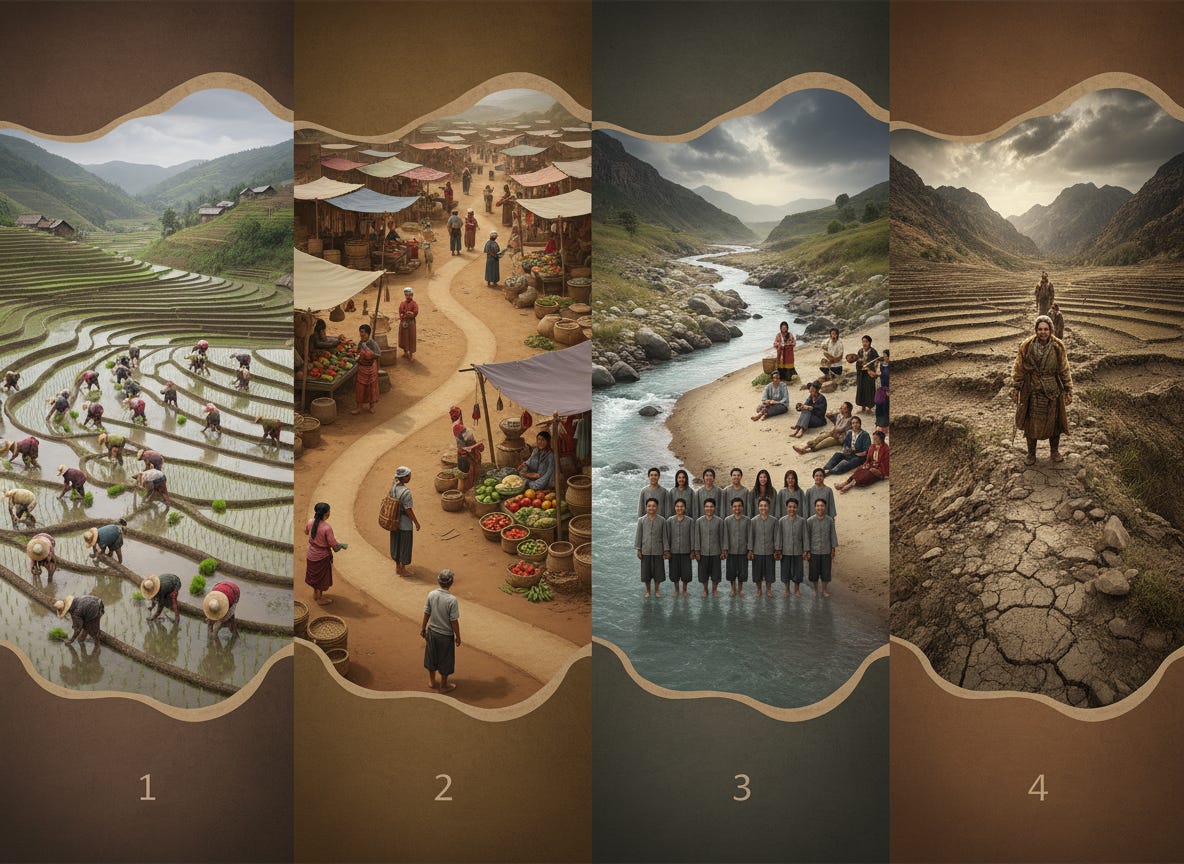
Four hypotheses offer answers. Each identifies a different mechanism. Each explains some cultural dimensions well and others poorly. Together, they account for most of the stable variation observed across societies without resorting to national character claims or ideological explanations.
Thomas Talhelm’s Rice Hypothesis argues that agricultural methods requiring coordination produce collectivist social structures. Rice farming demands shared irrigation and synchronized labor. Wheat farming does not. The social organization required to grow food becomes the template for social organization in general.
Joseph Henrich’s work on market integration shows that societies with larger commercial networks develop trust among strangers, standardized rules, and abstract fairness norms. Markets require dealing with people outside your family and village. This shifts cultures away from kinship obligation toward rule-based interaction.
Michele Gelfand’s research on cultural tightness and looseness examines how strongly societies enforce their rules. Tight cultures punish deviation. Loose cultures tolerate it. This dimension operates independently of what a culture actually values.
Daan van de Vliert’s work on climate harshness demonstrates that ecological risk increases dependence on hierarchy and coordination. When survival margins are thin, authority structures and strict norms become adaptive. Harsh environments produce tighter, more hierarchical societies.
These mechanisms explain why the same policies produce different outcomes in different places. Why some societies adopt new institutions easily while others resist. Why international negotiations between certain countries succeed while others talk past each other.
They also explain cultural persistence. The conditions that shaped a culture may have changed, but the social structures remain. Southern China is no longer primarily agricultural, but the collectivist patterns forged by rice cultivation persist.
Tuesday examines the Rice Hypothesis: how subsistence systems create collectivism, high-context communication, and obligation-based norms.
Wednesday covers market integration: how commercial exchange produces individualism, universalist ethics, and explicit communication.
Thursday addresses tightness and looseness: how norm enforcement intensity varies independently of cultural content.
Friday explores climate and ecological harshness: how environmental risk shapes hierarchy and uncertainty avoidance.
Saturday synthesizes the four mechanisms, examining how they interact and where the framework reaches its limits.
Culture is not destiny. But it is also not arbitrary. The patterns that shape how billions of people think and act emerged from material conditions that can be identified, studied, and understood.
If you enjoyed this article, buy me a coffee!


Really brilliant framing on this materialist lens. The rice vs wheat comparison makes teh interdependence piece tangible in a way that abstract cultural theory usually misses. I've seen how modern supply chain management still reflects these old coordination patterns, even in contexts where the original farming method is long gon. What's intresting is how tech companies struggle with this when they expand globally and expect one org model to just translate.