

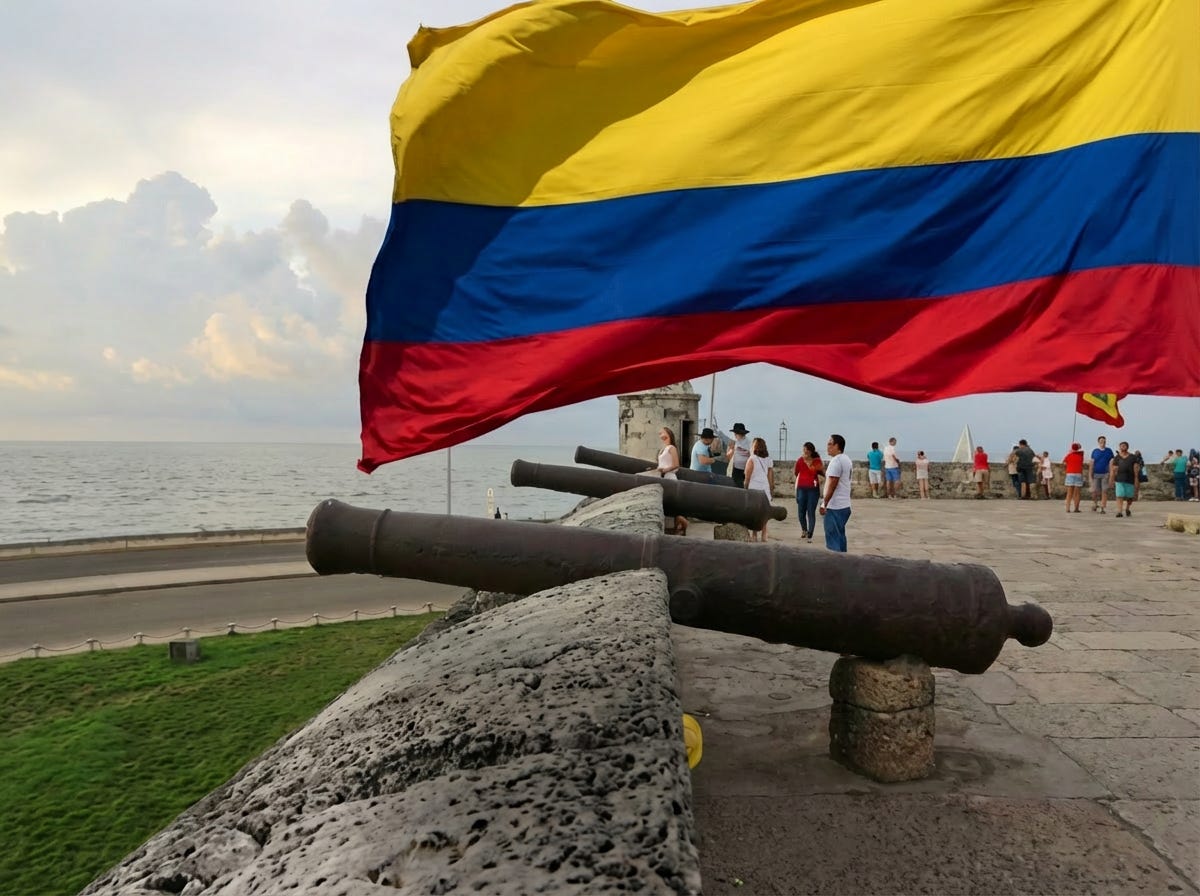
Colombians vote for president on May 31, 2026. Three candidates lead: Iván Cepeda Castro runs for the left, Abelardo de la Espriella runs for the hard right, Paloma Valencia runs for the center-right.
No one is near 50 percent. A runoff on June 21 is almost certain. The question now is, who finishes first on May 31?
Polymarket puts Cepeda at 89 percent on thin volume. I think Polymarket is wrong.
The Cultural Dimensions
Colombian culture pulls in two directions, and the pull decides first-round winners.
Trompenaars describes Colombia as Particularist, Communitarian, Ascriptive, and Emotional. Who your family is matters more than rules and laws. Group loyalty is more important than individual merit. Status is inherited. Emotion is expected in public. Schwartz scores Colombia high on Conservatism. Colombians want tradition, security, and conformity. And Hofstede places Colombia high on Power Distance and Uncertainty Avoidance. People defer to hierarchy and want order. Together, this means voters want stability and they want a leader who clearly stands for right and wrong. They trust family and their region more than anyone else.
The complication is that Colombia’s regional identities have never come together into a single national unit. Ibn Khaldun’s asabiyyah (group cohesion) is low among the elites and therefore, coalitions break easily. A candidate who has already consolidated a bloc has the advantage and Cepeda has that. The right has two candidates competing for the same voters.
The Historical Patterns
Five historians describe the forces underlying the race.
Fernand Braudel’s longue durée holds that surface events sit atop long-running forces. In Colombia, those forces are Andean geography, the cocaine economy, and land inequality. Land inequality has favored the left in every post-1991 cycle. Ibn Khaldun’s asabiyyah predicts the right splits because its elites are divided. Giovanni Arrighi’s systemic cycles say US influence in the region is waning, which opened space for Latin America’s left wave, and Cepeda continues it.
If you are enjoying this article, help support my work by becoming a paid subscriber or “buy me a coffee.”
Oswald Spengler’s Caesarism says late-stage democracies produce strongmen without parties, ruled by personality and money. De la Espriella is that figure: a media lawyer with no party machine, campaigning on a cult of personality. Carroll Quigley’s Age of Conflict says institutions that worked well in the past get stuck in the past and don’t move forward. Valencia is running the 2002 Uribista security playbook in 2026 for voters whose priorities have changed.
Every first-round winner in Colombia since 2002 has been a candidate from former president Álvaro Uribe's conservative movement or an anti-establishment insurgent. This helps de la Espriella and Valencia. It hurts Cepeda.
The Archetypes
Three of Hornby’s archetypes apply
Cepeda is Blue, the Guardian. Blue protects rules and moral tradition. Cepeda is a human-rights prosecutor who pursued Uribe in the courts for a decade. He is not a visionary. He enforces the rules. His Blue carries the left’s victim-justice tradition.
De la Espriella is North, the Power seeker, in an extreme form. North builds a cult of personality, frames himself as a national savior, and bends rules when convenient. He fits the caudillo slot Colombian culture fills in crisis years, Uribe in 2002, and Petro in 2022.
Valencia is also Blue. She is the best cultural match for Colombia’s Blue layer. The problem is that a Blue and a North on the same side split the vote. Right-wing voters who want Blue’s stability vote for Valencia, those who want North’s charisma vote for Espriella and neither wins.
The Other Factors
Five factors point right. One points left.
Polling: A November 2025 Invamer poll had Cepeda at 31.9 and de la Espriella at 18.2. The April 2026 AtlasIntel poll indicated all three top candidates are now polling in a narrow band, between 26 and 28 percent. The gap between them has closed.
Mobilization: On March 8, about 7 million people voted in the right's primary. Only about 830,000 voted on the left side. That is an 8-to-1 turnout gap.
Security: Senator Miguel Uribe Turbay was assassinated in June 2025. ELN peace collapsed in January 2026. The Catatumbo crisis killed over 100 people and displaced 55,000. Security is the number one voter concern, and that favors the right.
Economy: Petro’s approval sits near 29 percent. Inflation runs 5.5 to 6.3 percent. Colombia’s central bank raised rates. When the economy is bad, voters vote against the current government's candidate, and that’s Cepeda.
The Prediction Markets
Polymarket gives Cepeda an 89 percent chance of winning, but the volume behind that number is thin. Thin markets are less accurate.
