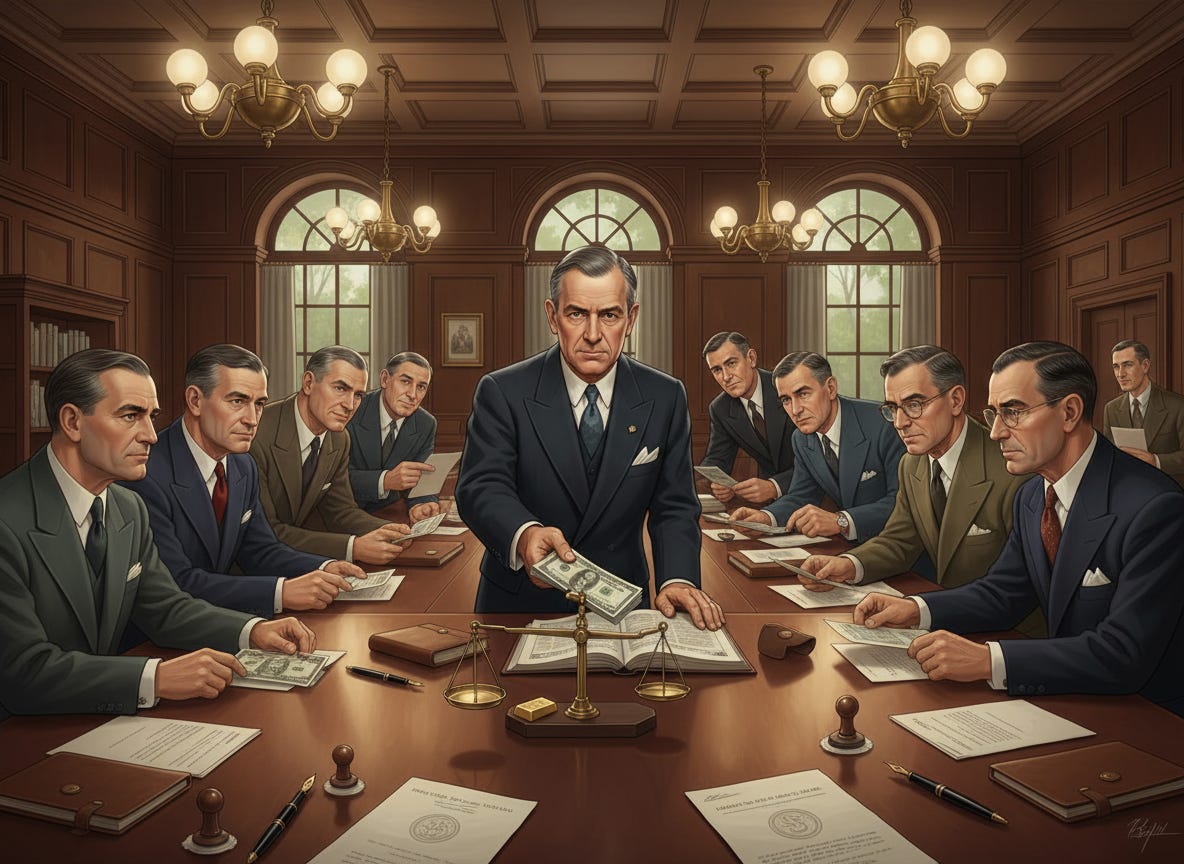
China's Game: The Bretton Woods System. Tuesday's Edition
How China Is Winning And Will Win The World. Series 21 #2
American dollar hegemony and the Bretton Woods institutions continue operating. Its architecture still determines who can trade with whom, who can be cut off from global finance, and which currency is used for every major transaction in virtually every nation.
In July 1944, with World War II still in progress, 44 Allied nations sent representatives to a hotel in New Hampshire. The war’s outcome was no longer in doubt; the question was what the postwar world would look like. Every major economy except America’s was destroyed and deeply indebted. The US held 70% of global gold reserves and was the world’s largest creditor and manufacturer. The U.S. held all the power at the time, and Bretton Woods set it up to maintain that power permanently.
The system had three components. The dollar was pegged to gold at $35 per ounce, every other currency was pegged to the dollar, and the International Monetary Fund and World Bank were created to manage global liquidity. In practice, this meant every nation that wanted to participate in global trade needed dollars.
This created what economists call exorbitant privilege. When you issue the currency everyone else uses, you finance your own debt cheaply because demand for your currency is guaranteed. You run deficits that would bankrupt any other nation because your creditors need your currency to function. And you weaponize the system when necessary: cut a country off from dollar access, and you cut it off from global trade. This is the root of American power.
Bretton Woods is Trompenaars’ universalism forced on the world. Universalist cultures impose uniform rules on all parties, regardless of circumstances or relationships. America didn’t negotiate bilateral arrangements with 44 nations. It proposed a single set of rules controlled by the dollar and applied them universally. Countries that wanted to trade had to accept those rules. Countries that didn’t comply were excluded from the system.
Britain’s chief negotiator, John Maynard Keynes, proposed an alternative. His Bancor was a neutral international “unit of account” in place of a reserve currency managed by a global body, not controlled by any single nation, and in hindsight, prevented any country from weaponizing the financial system through sanctions. The US said no. That rejection was consistent with Trompenaars’ internal direction: America believed it controlled the situation and had no intention of subordinating that control to a neutral institution.
U.S. President Nixon ended the dollar’s gold convertibility in August 1971, but dollar dominance continued. By then, the system had self-reinforcing mechanisms that no longer needed to be backed by gold. Oil was priced in dollars, trade settled in dollars, and national reserves were held in dollars. Countries had built their entire financial infrastructure around access to the U.S. dollar.
Hornby’s North archetype describes the power-seeking drive: ambition, authority exercised through idea-based decision-making, and the consistent rejection of others’ proposals unless they serve the American agenda. Keynes presented the stronger technical argument at Bretton Woods. The US rejected it because the North archetype doesn’t adopt superior ideas from competitors. It builds systems that make competitors dependent.
Wednesday’s Edition traces how America engineered that dominance, beginning not in 1944 but in the years before WWI, when the deliberate strategy to displace the pound sterling first took shape.
Sidebar: The Bretton Woods agreement
The US dollar as the world’s reserve currency
The dollar pegged to gold at $35 per ounce
All currencies pegged to the dollar at fixed exchange rates
The International Monetary Fund (IMF), to provide short-term loans to countries
The World Bank, to provide low-interest loans, technical assistance, and policy advice to developing nations
A framework requiring member nations to maintain their currency’s exchange rate within 1% of the fixed parity, intervening in currency markets when necessary
The World Trade Organization (WTO), originally The General Agreement on Tariffs and Trade (GATT) establishing rules for international trade
If you enjoyed this article, help support my work by becoming a paid subscriber or “buy me a coffee.”


