China: Trump The Nation Builder - Tuesday's Edition
Trump: good or bad for the world?
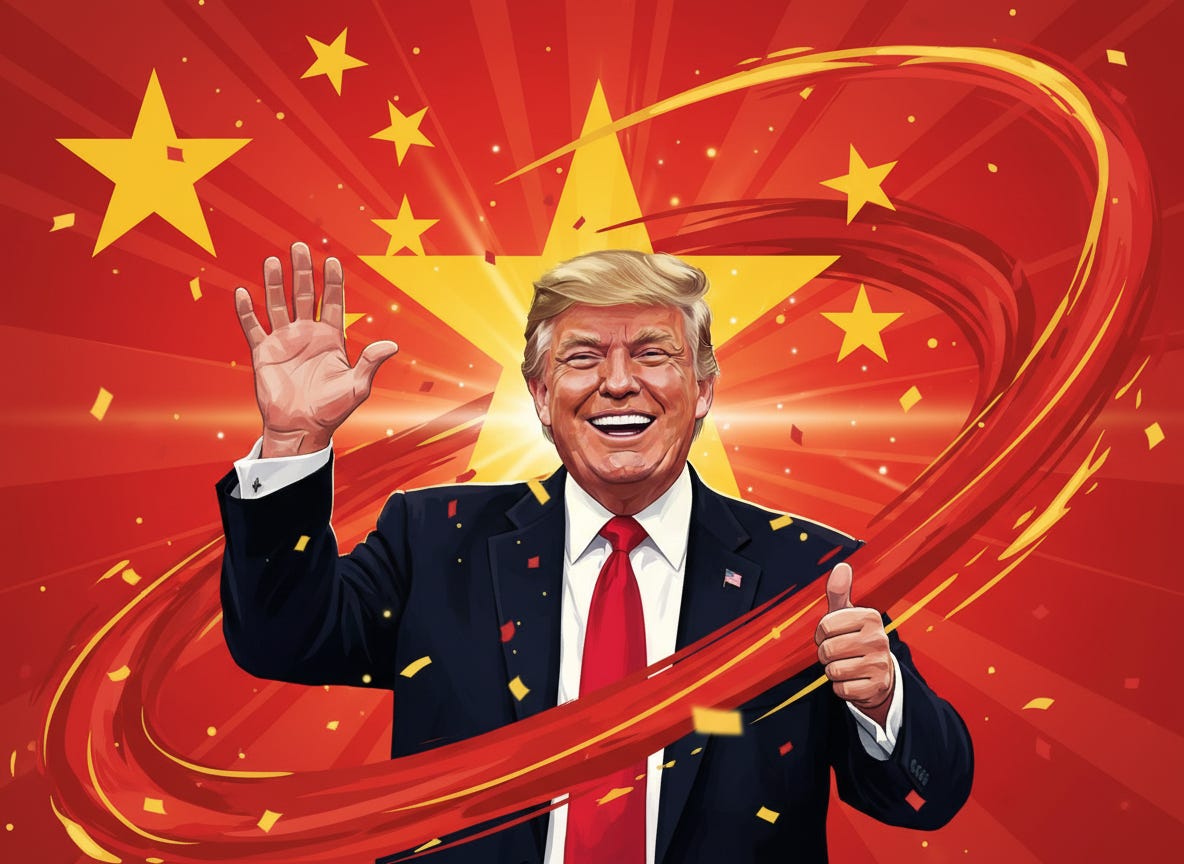
Somewhere on the Chinese internet, probably in a comment on some video of Trump, someone typed three characters: 川建国. Chuan Jianguo, “Trump the Nation Builder.”
The joke requires context. Jianguo was what you named your son if he was born around 1949, the year Mao declared the People’s Republic. It’s a revolutionary name, a founding-father name. Sticking it on Donald Trump is Chinese internet sarcasm at its finest, the kind that cuts clean because it contains an uncomfortable truth.
The nation he builds is China, not America.
This month, China announced something no country had ever achieved: a trade surplus exceeding one trillion dollars. Not despite Trump’s tariffs, but because of them.
Let that settle. The tariffs were supposed to cripple Chinese exports. Bring Beijing to its knees. Instead, China posted the largest trade surplus in recorded human history. Shipments to America dropped 29 percent, sure. But global exports climbed 5.9 percent. China found other customers. Americans got higher prices.
The Chinese internet trolls weren’t wrong. 川建国.
Fons Trompenaars’ work on internal versus external direction helps explain this. It’s one of those ideas that sounds academic until you see how it works.
Internal direction cultures believe you control your environment. You impose your will. You make reality bend. This is how Trump operates. It’s how a lot of Americans operate, actually. Americans are raised on stories about conquering frontiers, overcoming nature, and manifesting destiny. The world is raw material, exploit it for your wants.
External direction cultures believe you work with your environment. You read the currents. You adapt. You don’t wade waist-deep fighting a river to cross it; you build a boat and go with the current. This is the Chinese cultural perspective, and it explains everything about how Beijing responded to Trump’s trade war.
Trump believed he could force China to submit. He did not understand that China adapts.
When Trump blacklisted Huawei in 2019 and pressured allies to ban their equipment, he expected Huawei to collapse. Instead, their global market share in telecom equipment went from 32 percent to 34 percent. Over 3.2 billion people outside China now live in countries running Huawei 5G. American companies lost more than $33 billion in sales they’ll never recover. Trump’s punishment approach pushed China to build exactly what America tried to prevent.
The same story with chips. Export controls created what one analyst called “the worst of both worlds: undermining American companies’ competitiveness while failing to meaningfully slow China’s progress.” Nvidia and AMD hemorrhaged billions in restricted China sales, money that would have funded the R&D needed to stay ahead. Meanwhile, DeepSeek built an AI model matching leading American capabilities, trained on fewer chips. Trump banned Nvidia’s H20, unbanned it, lifted restrictions on the H200, changed his mind again. Customers stopped waiting for Trump’s mood swings and bought Huawei instead.
There’s another dimension here, what researchers call long-term orientation. It’s the cultural capacity to plan and measure success over decades rather than quarters. China’s response to the tariffs wasn’t improvised. It was the execution of contingencies established during Trump’s first term. Years of preparation for exactly this moment. The patience required for such planning reflects a cultural perspective that American quarterly-earnings thinking cannot match.
But let me back up, because the trillion-dollar surplus didn’t happen in isolation.
In 2017, Trump pulled out of the Trans-Pacific Partnership on his first day in office. TPP was designed to contain China by setting rules for 40 percent of world trade without Chinese participation. It would have forced Beijing to choose: accept American-led standards or lose access.
China responded by forming the Regional Comprehensive Economic Partnership. Thirty percent of world trade. Rules written in Beijing. America not invited.
Trump withdrew from the WHO. From the Paris Agreement. From one international organization after another. China filled every vacuum. Much of the world now looks to Beijing for leadership and funding, and funding is power. Trump cut foreign aid. China committed $50 billion to African development. Medical centers. Two thousand medical personnel. Support for the Africa CDC. While America retreated, China wrote checks.
Electric vehicles. Batteries. Drones. The pattern repeats. China dominates because Trump’s policies accelerated its dominance.
M.J. Hornby’s archetypes offer one way to understand how China operates as a state. Blue, the Guardian: inner certainty about what must be done, imposing structure and discipline. West, the Sage: patient, calculating, accumulating knowledge through methodical problem-solving. Together, they produce a nation that plans carefully and executes with certainty.
And then there’s collectivism. The willingness to sacrifice now for strength later. The cultural assumption that individual interest serves collective interest, that “we” comes before “me.” It’s not better or worse than American individualism. It’s different. And in a trade war requiring patience and coordination and the ability to absorb short-term pain, it is an advantage.
I don’t know if Trump intended any of this. I don’t know if he’s working with Xi or if Xi simply recognized a useful fool when he saw one.
What I do know is 川建国 - Trump the Nation Builder.
The joke writes itself. The punchline is the US.


What this shows is chinas meticulousness in the face of American hubris. This was a very interesting analysis and it’s changed my views on china’s foreign policy
Trump played right into their hands.