

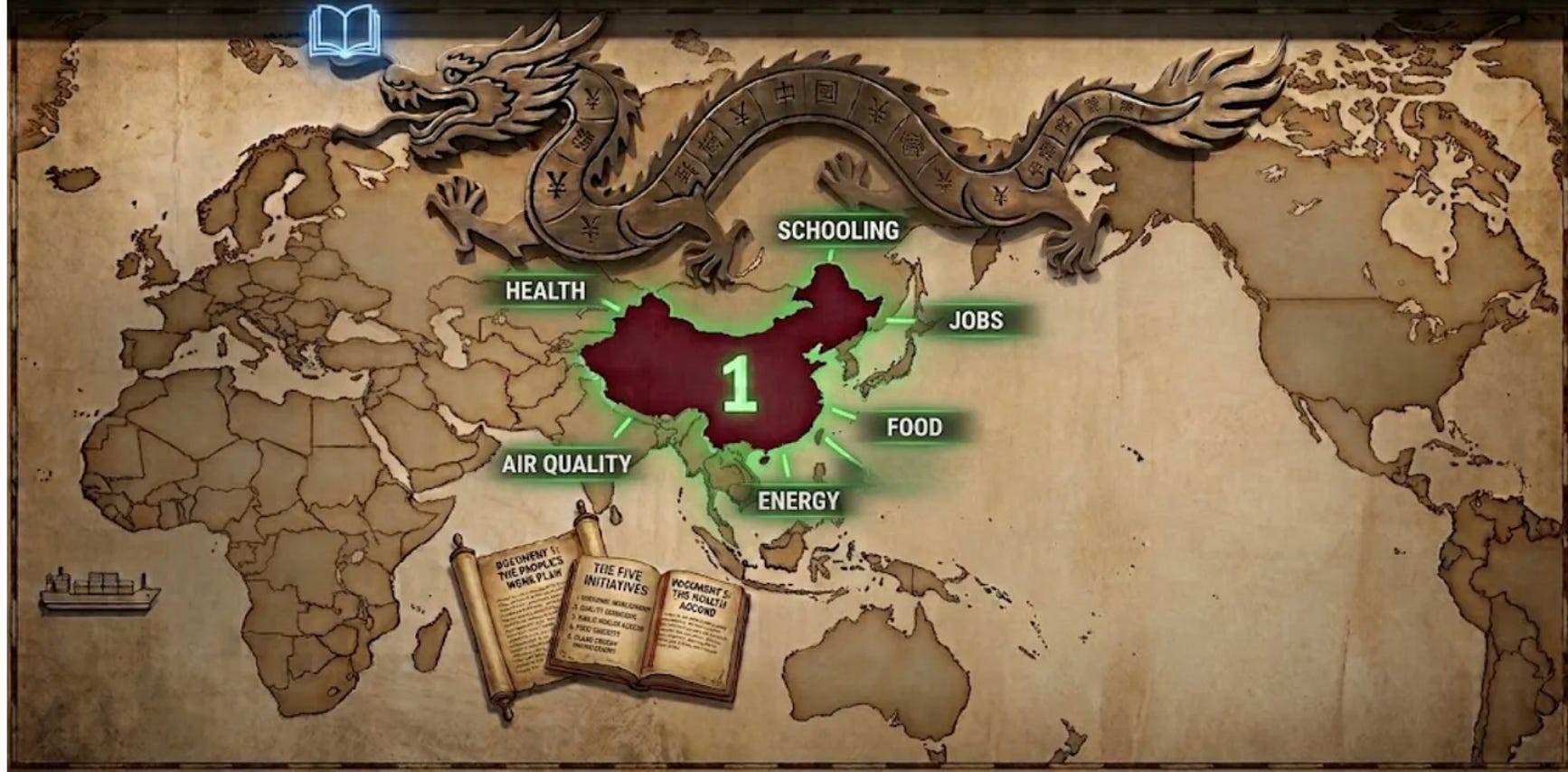
Western governments, particularly the U.S., describe China as a country preparing to take territory, spread communism, and control world trade. But that's not what China is planning. We know this because:
China plans; it is Long-term Oriented (Hofstede)
It communicates in detail; it is a Slow Message Culture (Hall)
It works together as a unit; it is Collectivist (Hofstede)
If we read the documents that Chinese leaders are writing to guide China over the long term, then we know the direction it is headed.
The three documents below make it clear that China is focused on jobs, schooling, health, food, energy, and air quality. Not taking territory, spreading communism, and controlling world trade
The 15th Five-Year Plan, adopted on 12 March 2026.
The plan sets clear goals for research spending, unemployment, life expectancy, years of schooling, grain capacity, energy capacity, carbon intensity, air quality, water quality, and forest cover.
It does not set economic growth targets. Reading between the lines (High Context Communication), which is how China’s culture communicates, explains even more: A plan specifying forest cover to one decimal place but not setting economic growth rates makes it clear where Beijing’s focus is.
The 20th Party Congress work report, 16 October 2022.
The Communist Party of China is working to create a strong, modern socialist country. National defense appears in the report, in a short section on modernizing the armed forces by 2035 and a passage on Taiwan where the Party states it will not rule out the use of force.
It also discusses international influence. The document does not describe what “influence” means, but other documents state that China is asking for:
Security Council enlargement favoring developing countries
Intergovernmental negotiations kept as the only channel for Council reform
IMF quota share adjustment
World Bank shareholding review
and several other equally exciting requests. The bottom line: they want a larger vote in existing institutions such as the IMF and World Bank.
The Third Plenum resolution, 18 July 2024.
This sets the date for the reforms: 2029, the 80th anniversary of the People’s Republic. The subjects are markets, the tax system, banks, regional development, and the courts. All domestic Chinese affairs.
This is where China is putting its energy, finances, and time. This is good news for the world because the goals that extend beyond China’s borders, such as carbon intensity, air quality, and forest cover, benefit all of us.
As China increases its food production, it buys less on world markets, making more available to poorer countries that import food.
Research spending produces technology other countries buy and use.
Asking for UN Security Council enlargement favoring developing countries gives smaller countries a larger say and makes a more equitable world.
A government spending its money on schooling, hospitals, food and clean air is spending it on making people’s lives better.
Friday’s Edition looks at the military and global aspirations.
If you enjoyed this article, help support my work by becoming a paid subscriber or “Buy me a coffee.”
Get a solid understanding of Trompenaars’ cultural dimensions by purchasing the guide or subscribing to Cultural Perspective (free or paid) and receiving the guide for free.
