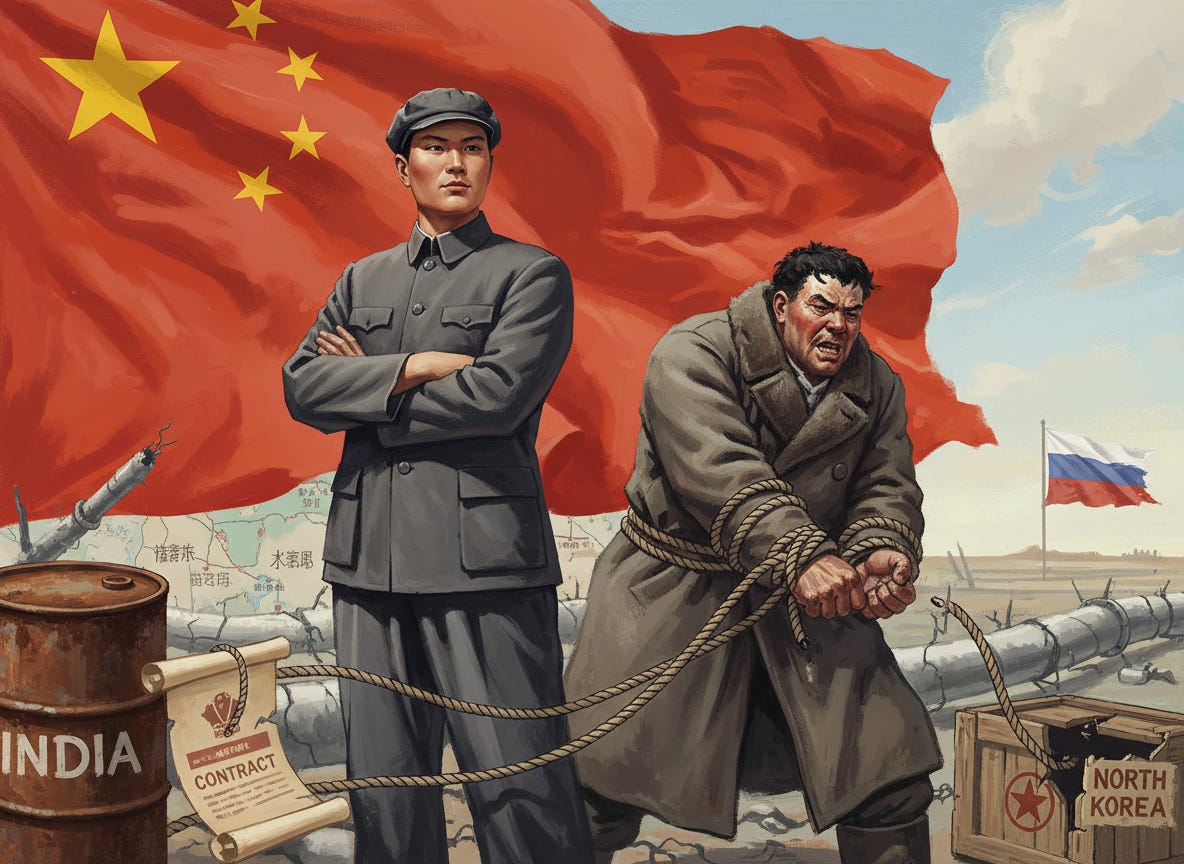
CHINA AND RUSSIA - THE TRAP. THURSDAY'S EDITION
The Long Game: How China Is Taking Back What Russia Took - Series 12 #4
Russia knows what is happening. Russia cannot stop it. It is in the trap.
Face is about who must come to whom, who asks, who decides. When the asking and deciding reverse, face reverses. For 160 years, Russia decided, and China asked. Russia took territory, set trade terms, and dictated what China could and could not invest in. Now Russia asks, and China decides. Russia is becoming China’s junior partner. Russia knows this and is trying to prevent it, but it can not.
Russian analysts use the phrase “junior partner” in their own commentary because the numbers make that clear. China accounts for 34% of Russia’s trade, but Russia accounts for 3% of China’s. Russia exports raw materials to China, and China exports finished products back to Russia. This is more like colonialism than a trade partnership. But Russia is not passive about this imbalance. It is pulling from its internally directed cultural perspective, trying to force the issue to reduce dependence on China. India now buys 35-40% of Russian oil exports. Russia pursued this aggressively, offering discounts and building ties through defense sales and BRICS. If Russia can balance China with India, it keeps some leverage.
Russia also signed a 20-year strategic partnership with Iran in January 2025. It pulled North Korea closer, trading weapons technology for ammunition and labor. Neither replaces China, but both reduce total dependency. At the same time, Russia has blocked Chinese expansion where it can. Moscow stopped the Shanghai Cooperation Organisation from becoming a free trade zone, which would have strengthened China’s grip on Central Asia. Russia still has not formally joined China’s Belt and Road Initiative despite years of pressure. Since 2015, foreign workers in Russia must pass language and history tests. China asked Russia to waive this for Chinese workers. Russia refused.
An externally directed culture means working with forces already in motion. China works with forces, and Russia pushes against them; this favors China. Russia needs cash for the war. China has cash. Russia needs energy buyers. China buys energy. Russia needs manufactured goods. China makes them. Every countermove hits the same wall: Russia cannot refuse its largest customer while fighting its largest war.
India buys Russian oil but cannot absorb the volume of oil Russia needs to sell, and the Trump administration is now pressuring India to reduce purchases. If India complies, Russia becomes more dependent on China.
Iran and North Korea provide ammunition and political support, but neither has money. They take as much as they give.
The Power of Siberia 2 pipeline was supposed to expand gas sales to China. China is stalling, and years of negotiation have produced nothing. China refuses to agree on pricing, and the pipeline was not mentioned at the 2024 Putin-Xi meetings. China decides if the deal happens because Russia is now the junior partner.
The 2025 Eastern Economic Forum in Vladivostok was meant to showcase Russia’s Asia strategy. Japan, South Korea, Thailand, Indonesia, and Singapore sent no representatives, and not one major international contract was signed.
Short-term orientation explains why Russia continues to use a failing strategy. The war demands resources now, and China provides them now. Every alternative produces less than China provides, thus the countermoves prevent total dependency but cannot reverse the asymmetry. Russia protects face while losing position. Moscow maintains the rhetoric of equal partnership. It blocks symbolic initiatives like refusing to join the BRI and insisting on respect at summits. The rhetoric preserves face while China gains more power. Chinese companies provide 90% of foreign investment in the Russian Far East, Chinese workers fill jobs, and Chinese names appear on Russian maps.
Russia sees what is happening. The countermoves prove awareness. They also show Russia is all but helpless; it is well into the trap.
If you enjoyed this article, buy me a coffee!


