CHINA AND RUSSIA - THE STRATEGY. WEDNESDAY'S EDITION
The Long Game: How China Is Taking Back What Russia Took
In the 1860s, Russia took massive tracts of land from China. Today, China is not demanding or even asking Russia for its territory back, but it is making the territory Chinese. China is doing this with a mix of high-context communication and long-term orientation .
High-context cultures do not state demands directly. They signal, imply, and create conditions and let others draw conclusions. Long-term cultures do not expect or work for immediate results, the plan in years and decades. What looks like nothing happening is actually everything happening.
In February 2023, China’s Ministry of Natural Resources ordered that eight Russian cities and territories be relabeled to their original Chinese names on all official maps. Vladivostok reverted to Haishenwai, Khabarovsk reverted to Boli, Sakhalin reverted to Kuedao, Blagoveshchensk reverted to Hailanpao, Ussuriysk reverted to Shuangchenzi, and the Stanovoy Ridge reverted to Waixinganling. The Kremlin could not protest because there was nothing explicit to protest. That is high-context communication: the message is clear (these are Chinese), but exists only in implication.
The change matters enormously over time. Chinese schoolchildren now see Haishenwai on their maps. Not a Russian city with a strange name. A Chinese place with a Chinese name that happens to be under foreign control. Like Hong Kong and Macau were. This is the long-term cultural perspective. The names do nothing today, but they change how the next generation thinks about those territories. They make recovery feel like restoration, not conquest. They make eventual control feel right because the land was always Chinese. The names said so.
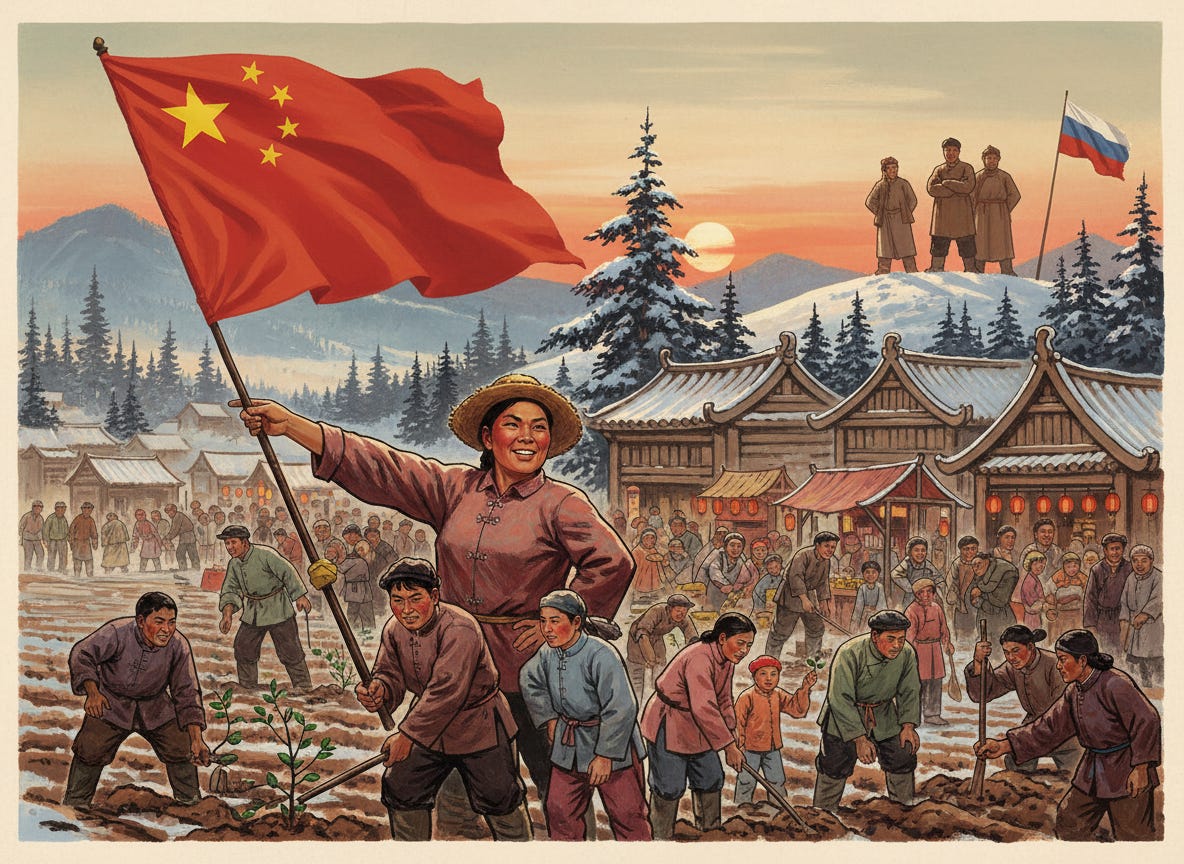
The Russian Far East has 6.3 million people spread across a territory larger than India. Across the border in Chinese Manchuria live 110 million people. That is seventeen Chinese for every Russian. The imbalance is not new, what is new is how freely the Chinese can now cross into Russia. In September 2025, visa-free travel began. Chinese citizens can stay in Russia for 30 days for business, tourism, or family visits. The official purpose is tourism and trade, but from China’s cultural perspective, something else is happening. Enclaves are forming in Siberia where local Russians do not work or live, and profits go directly to China. Chinese businesses operate in Chinese, hire Chinese workers, and serve Chinese customers. The territory is officially Russian on paper, but in all other respects, it is Chinese. This is an invasion, from a cultural persepctive the West finds difficult to understand.
Chinese investment in the Russian Far East reached 49 projects worth nearly $9 billion by the end of 2023. More than 90% of foreign direct investment in the region comes from Chinese state companies. The sectors include energy, mining, agriculture, timber, and increasingly, infrastructure. Every investment creates dependency. Russian workers depend on Chinese employers, Russian suppliers depend on Chinese buyers, and Russian local governments depend on Chinese tax revenue. Cut the investment, and the region collapses. China is in effective control
This is external direction: working with forces rather than against them. China did not create Russia's need for investment, the sanctions did. China did not empty the Russian Far East of workers, decades of migration to Moscow did. China did not drive Russia into desperation for cash, the war did. These circumstances existed, and China positioned itself to benefit from them. External direction means you do not force outcomes, you find where the river is already flowing and build your mill there.
Names on maps change how Chinese people see the territory. People on the ground change who actually live and work there. Money changes who depends on whom. High-context communication and long-term orientation together are hard to resist and impossible to reverse once they reach a critical mass.
Russia sees what is happening, but cannot stop it, because stopping it would mean losing its primary means of support. So the strategy continues, the names settle into Chinese minds, the people settle into Russian lands, the money settles into Russian dependency.
The lands become Chinese again.
If you enjoyed this article, buy me a coffee!


