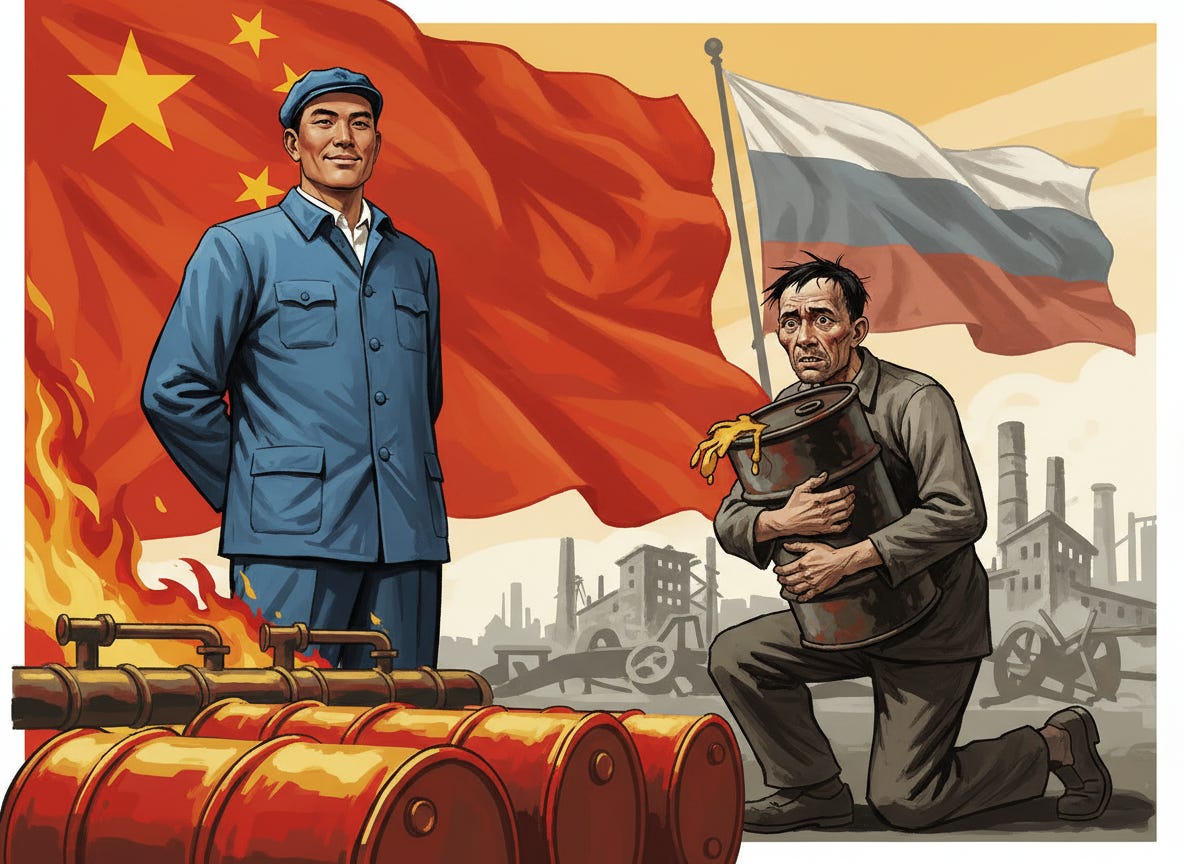
CHINA AND RUSSIA - THE CATALYST. TUESDAY'S EDITION
The Long Game: How China Is Taking Back What Russia Took
Before February 2022, Russia could say no to China. It no longer can.
Moscow sold oil and gas to Europe. German factories ran on Russian energy. The Nord Stream pipelines connected Russia to its richest customers. When China wanted better terms, Russia had options. It could play East against West, extract concessions from both, and keep its independence.
The invasion of Ukraine ended that.
Western sanctions closed European markets, the pipelines stopped flowing or got blown up, and over a thousand Western companies left Russia. Overnight, Russia lost its primary customers, its technology suppliers, and its financial connections to the developed world. China remained.
Today, China buys 47% of Russia’s crude oil exports. Russia accounts for 36% of China’s trade, but China accounts for just 5% of Russia’s. Russia needs Chinese buyers while China has dozens of alternative suppliers. That asymmetry is leverage, and China is using it.
The numbers tell the story. Russia now sells oil to China at prices 15-19% below market value. Natural gas flows to China through the Power of Siberia pipeline at $261 per thousand cubic meters. The European price is $402, that’s a 35% discount that saves China billions every year. Russia accepts less because it has no choice; less is better than nothing.
But discounted energy is only the beginning.
From a cultural perspective, what matters is not just the money, but China regaining face. Face is about standing in a relationship, who sets the terms and who must accept them. Face is lost when you take conditions you would not choose. Face is gained when others must come to you. For 160 years, Russia had the power, and China had to accept what Russia offered. Russia took territory, blocked Chinese investment, and decided what China could and could not touch in sensitive sectors like defense and strategic resources.
Now Russia comes to China. In mid-2022, Russian Prime Minister Mikhail Mishustin proposed 79 projects worth $165 billion for Chinese investment across energy, mining, and agriculture. By May 2023, more than 90% of foreign direct investment in the Russian Far East came from Chinese state companies. Sectors that Russia once closed are now open. In late 2022, Moscow announced a special economic zone covering 6.96 million square kilometers, nearly half of Russia’s landmass, exclusively for Chinese investment. Now Russia needs China, and China makes the decsions. That is what face reversal looks like.
Putin’s May 2024 visit to Beijing showed the new order. He visited Heilongjiang province, the Chinese region that borders the territories Russia took in 1858. He repeatedly approved an expanded Chinese role in developing the Far East. The leader who once set limits now removes them.
Why would Russia accept terms it knows favor China? This is long-term versus short-term orientation in action. Some cultures plan in decades and generations, and others focus on this quarter, this year, this crisis. The difference shapes every negotiation.
Russia operates on a crisis schedule, a wartime schedule. Putin needs Chinese money now to pay soldiers, buy ammunition, and keep factories running. What happens in ten years is not his problem today. The war demands cash, China has cash which means China has the power. Russia takes the deal.
China operates on generational timescales. The Century of Humiliation lasted 110 years. Its resolution is still unfolding. Chinese planners know that arrangements that look slightly balanced in China’s favor today will tilt much further tomorrow. Every year of war drains Russia, every concession pulls China deeper into Russian territory and Russian industry, and China can wait.
There is another cultural divide at work: how each country tries to get what it wants. Russia invaded Ukraine to control its environment through force. Make Ukraine submit, Europe fear, and NATO back down. This is internal direction: impose your will, dominate circumstances, force the outcome you want. It is failing, three years in, Ukraine still fights, Europe still supports it, and Russia cannot force the result.
China takes the opposite approach. External direction means working with forces already in motion rather than forcing them. China did not create Russia’s crisis but China positioned itself to benefit from it. China did not create the demographic imbalance between 6 million Russians and 110 million Chinese across the border, but it will use it.
The Power Seeker, Hornby’s North archetype, drives both nations. Russia invaded Ukraine to dominate, to force its will on others. China seeks power with more complexity; the West Sage plans systematically, and the Blue Guardian works for justice. China's North-West-Blue blend positioned itself to collect the gains that Russia’s North Power Seeker blunders create.
The war was the catalyst, and dependency is the result. From a cultural perspective, three patterns converged. Russia tried to force an outcome through invasion; China positioned itself to benefit from forces already in motion. Russia sold its future to fund its present; China invested its present to own Russia's future, and with each concession, Russia loses face while China gains it back. The bills are just starting to come due.
If you enjoyed this article, buy me a coffee!


This analysis of asymmetric dependency is incredibly sharp. The face recovery angle through economic leverage makes so much more sense than traditional geopolitical takes that just focus on resources. What's wild is how Russias forced short-termism from the war actualy gifts China the exact timeframe advantage they already had culturally. I've seen similar dynamics insmaller negotiations where the party with the ticking clock always loses, but never at this scale.
“China operates on generational timescales” vs power & force = long term winking.