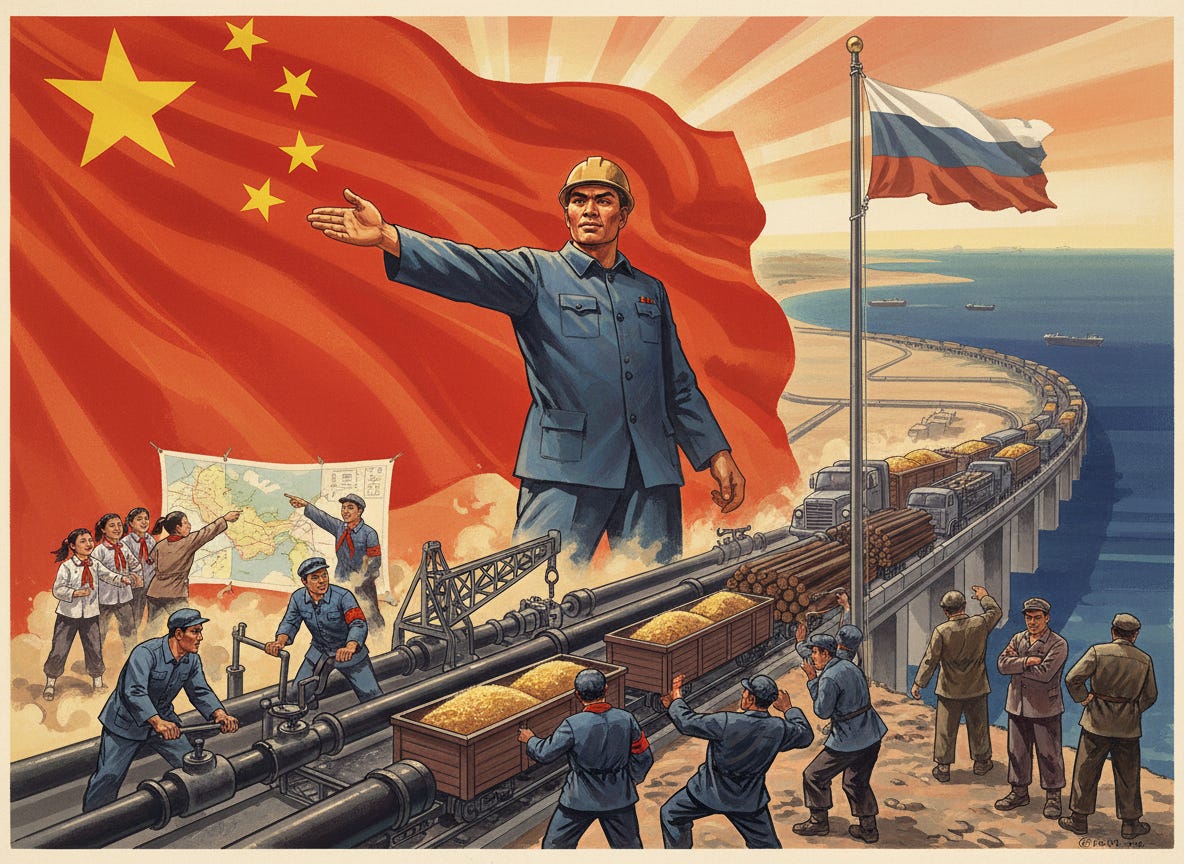
CHINA AND RUSSIA - RESOURCES AND FACE. FRIDAY'S EDITION
The Long Game: How China Is Taking Back What Russia Took - Series 12 #5
China lost face when it lost territory at gunpoint to Russia and other nations in the 1860s. Face in the cultural sense is not vanity. Face is standing, where you rank among nations, whether others must come to you or you must go to them. China regains face when that territory returns. But face alone does not explain China’s strategy to regain lost territory in the Russian Far East; resources do.
The two motivations work together. The practical need for resources gives China reason to act, and the cultural need to restore face makes the action absolutely necessary and never forgotten. Neither alone would produce this level of sustained effort, but together, they create a strategy China will pursue for as long as it takes, and it’s already taken 150 years.
China’s economy requires raw materials at industrial scale, oil, natural gas, timber, minerals, and even agricultural land along the border. China’s domestic supplies are insufficient therefore, China must import. The problem is how imports arrive. Most come by sea. Oil tankers cross the Indian Ocean, pass through the Strait of Malacca, and enter the South China Sea. The United States Navy could block those routes in a conflict, and China’s economy would starve.
The Russian Far East offers a solution. Oil and gas flow through pipelines that cross land borders with no chokepoints or American warships. The Power of Siberia pipeline already delivers 38 billion cubic meters of gas annually. Russian crude flows by rail and pipe.
From a cultural perspective, this is restraint in action. Restrained cultures delay gratification for long-term security. China could be aggressive and possibly wrest control of these areas from Russia now that Russia is bogged down on the Western Front. Instead, China is restraining itself and implementing a longer-term, more permanent strategy.
The Far East also contains timber, minerals, rare earths, and farmland. Chinese companies are already extracting these. By 2023, more than 90% of foreign investment in the region came from Chinese state companies. Control over extraction does not require owning the land, it requires owning the operations.
From a cultural perspective, face includes national standing across time, thus China’s loss to Russia does not expire. Chinese schoolchildren learn the map of territories lost during the Century of Humiliation. The curriculum names the countries that took Chinese land, and that Russia took the most, over one million square kilometers, including the entire northern Pacific coastline.
Other debts have been settled, the treaty ports closed, and Hong Kong and Macau returned, but the Russian debt remains open. The only foreign power from the Century of Humiliation that still holds what it took. This is not ancient history to China, it is unfinished business.
Practical needs and cultural grievances drive China in the same direction, and this is why China’s strategy is so persistent. If China only wanted resources, it could buy them on global markets with less political risk. If China only wanted face restored, it could press territorial claims through diplomacy or military posture more quickly and directly. Instead, China pursues both through the same patient strategy. Economic penetration secures resources while creating dependency, and dependency shifts power from Russia to China. The shift in power restores face. Each step serves both goals. This is also external direction, China is not forcing outcomes, it is using the forces already in motion: Russia’s weakness, its need for cash, and the empty Far East. These conditions existed, and China used them to its advantage.
In M.J. Hornby’s novel Seeking Ascension, the Blue archetype, the Guardian, helps explain why face matters so deeply. The Guardian is morally certain. It knows what is right, and recovering territory stolen at gunpoint is just. This conviction sustains patience.
Face operates at the national level in collectivist cultures. When China regains standing, the Chinese people feel it. The Communist Party’s legitimacy rests partly on the restoration narrative; The Century of Humiliation has ended, and the lost territories are returning. Completing that narrative strengthens the regime. Each step toward recovering the Russian Far East, maps renamed, the Chinese people moving in, controlling investments in the region, signals that the restoration is coming.
Resources benefit the economy, face benefits the Party.
If you enjoyed this article, buy me a coffee!


