Central Asia: Russia Is Losing It. Wednesday's Edition.
The five "stans" that may decide global power. Series 25 #2
In June 2022, at the St. Petersburg International Economic Forum, the president of Kazakhstan, Tokayev, shared the stage with Putin. Asked by the moderator about Russia's war in Ukraine, Tokayev said Kazakhstan would not recognize the self-declared Donetsk and Luhansk People's Republics. Putin, sitting beside him, did not respond.
That clip was seen across Central Asia. If there was a singular moment that Putin knew he’d lost Kazakhstan and Uzbekistan, and was slowly losing the rest of Central Asia, this was it.
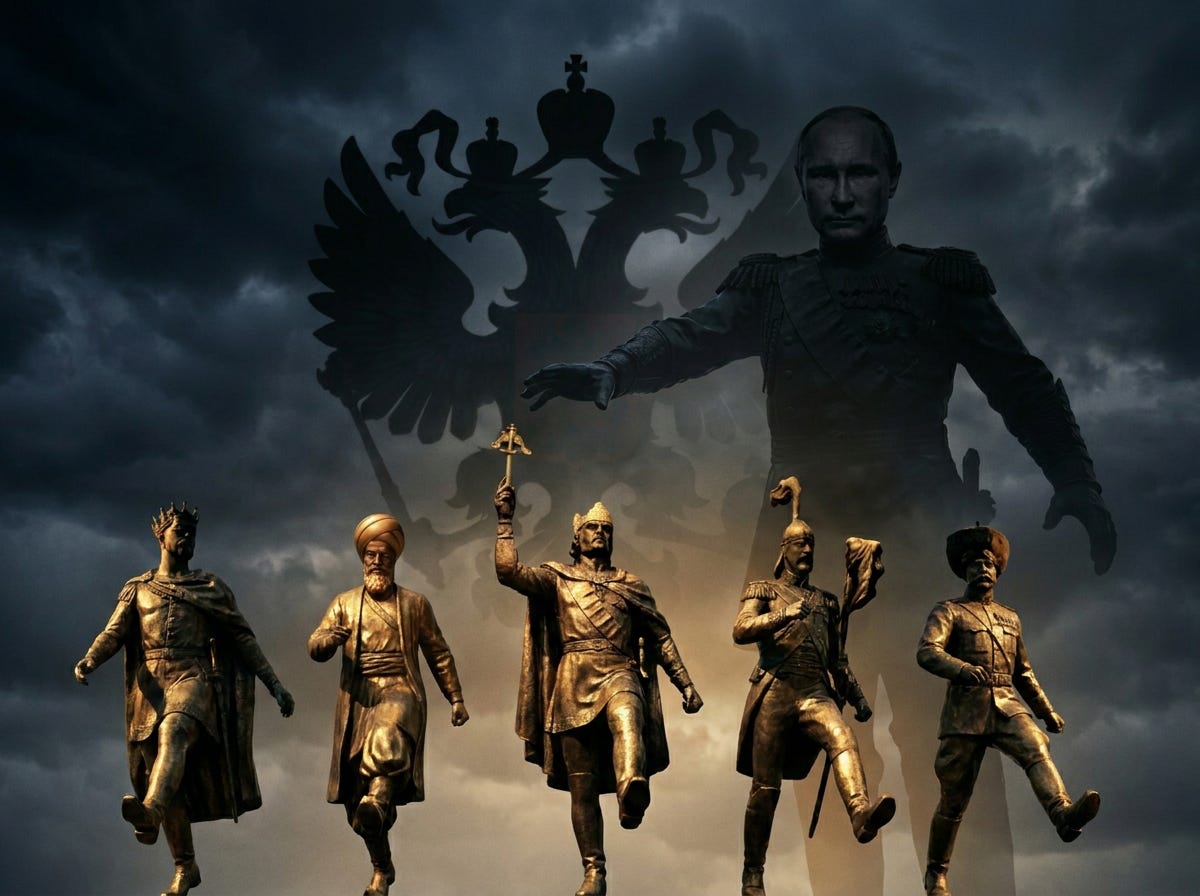
Russia had controlled Central Asia for 200 years, beginning in the early 1800s when the Tsars conquered the Khanates. The Soviet Union absorbed them as Soviet republics, and the Russian Federation maintained control through investment, language, and military integration. Putin’s invasion of Ukraine brought that to an end.
Western secondary sanctions made any bank that handled Russian transactions a risk. To eliminate that risk, Kazakh and Uzbek banks stopped working with Russian banks. As the war progressed, Russian firms pulled cash out of the Central Asian nations to cover war costs. Trade did not stop, but the share moving through Russian channels collapsed.
Kazakhstan still ships most of its oil through Russia from western Kazakhstan to a Russian port on the Black Sea, where the oil is loaded onto tankers and sent to Europe. Russia has used this dependence to pressure Kazakhstan, including by shutting down loading points at the Black Sea port and cutting off a second pipeline that carried Kazakh oil to Germany. These actions are only accelerating Kazakhstan’s move away from Russia
Turkmenistan sends most of its gas to China. Uzbekistan signed a critical minerals agreement with the European Union in 2024. The money doesn’t just skip Russian banks; it goes to other nations.
Kazakhstan adopted a 2023 to 2029 language plan that shifts everyday government work into Kazakh and lifts the Kazakh-language broadcast quota to 55 percent. Soviet-era monuments have come down in several cities. Enrollment in Russian-language schools has fallen every year since Russia’s invasion of Ukraine. None of the five governments have condemned Russia, nor have any supported it.
The Collective Security Treaty Organization (CSTO), led by Moscow, was supposed to create military unity among Russia and many of the Soviet Union’s former republics. In January 2022, when protests in Kazakhstan turned violent, CSTO troops, mostly Russian, arrived to help President Tokayev hold power. Weeks later, those same Russian units were redeployed to Ukraine. The CSTO has been hollowed out as a guarantee, but the bases remain. Kazakhstan, Uzbekistan, and Kyrgyzstan now run their own security planning. None has formally left CSTO, but none of them treat it as a real guarantee. Tajikistan now trains alongside Chinese units at the Pamir border.
For thirty years after the fall of the Soviet Union, the ruling class spoke Russian, studied in Russian universities, and treated Moscow as the reference point. That class is retiring. The generation now entering government was born after 1991, was schooled in its national language, and treats Russia as a neighbor, not the controlling influence.
This is the difference between a cyclical change and a structural change. Cyclical change reverses when a leader changes or sanctions lift. Structural changes do not reverse because the structures that produced them are gone. Russia does not have spare troops. It does not have spare cash. It does not have a generation that still defers to it. China, the European Union, and even the United States have moved into the power vacuum left by Russia. Russia won’t get it back.
Friday’s edition examines who is filling the power void: China as the dominant economic player, the European Union as the late but serious entrant, and the United States as the inconsistent third party. The fit between Chinese and Central Asian cultural perspectives explains why Beijing is winning the infrastructure and trade race.
Saturday’s Core Brief, for paid subscribers, predicts where each of the five states will be by 2030.
Russia held the region for two hundred years. Putin lost it in four.
If you enjoyed this article, help support my work by becoming a paid subscriber or “buy me a coffee.”


