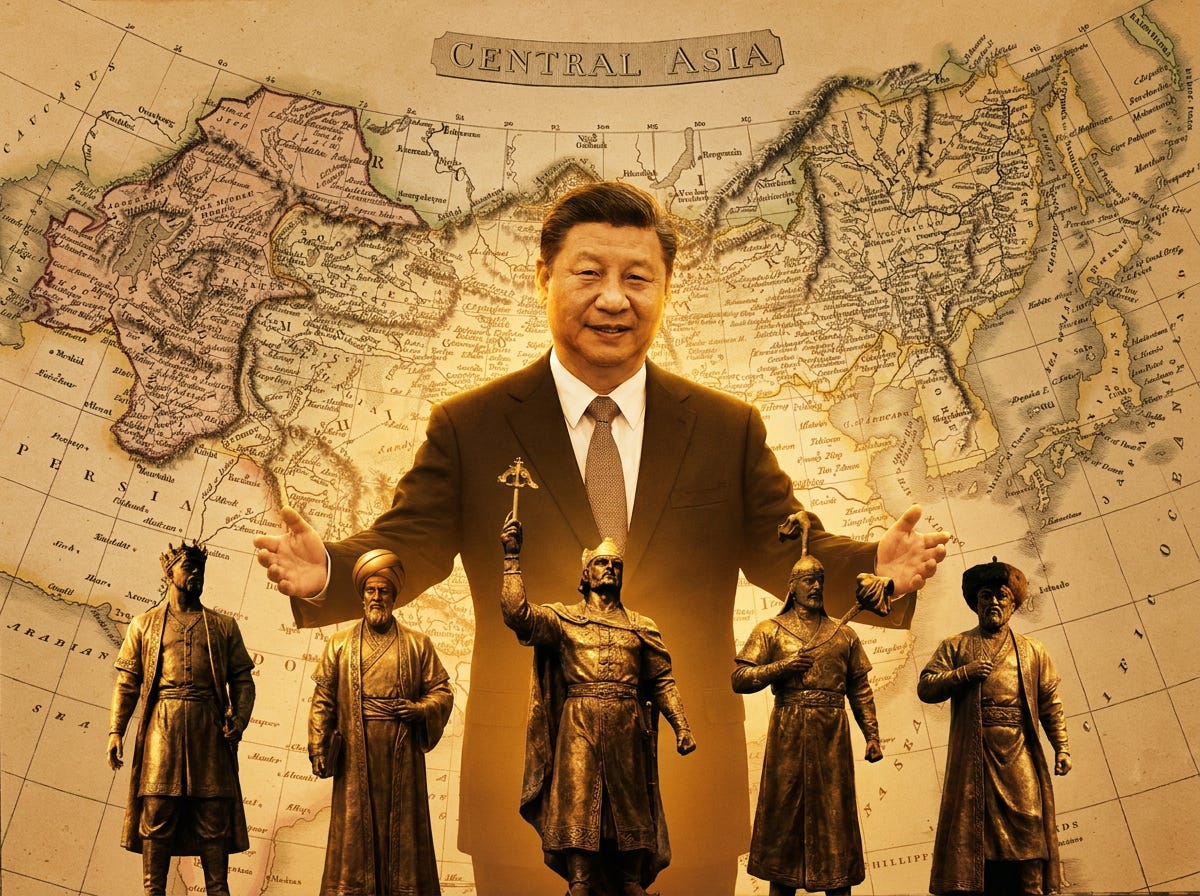
Central Asia: China Is Winning. Friday’s Edition.
The five “stans” that may decide global power. Series 25 #3
In September 2022, Xi Jinping made his first foreign trip since the start of the pandemic. He flew to Astana, the capital of Kazakhstan, to meet Kazakhstan’s president, Kassym-Jomart Tokayev, before going on to the Shanghai Cooperation Organization summit in Uzbekistan. In Astana, Xi promised China would “strongly support” Kazakhstan’s sovereignty and territorial integrity. The line was aimed at Putin. Delivering it in Kazakhstan before the summit was also a message to Putin: China is coming.
Kazakhstan is the largest Central Asian nation. It borders Russia from China to the Caspian Sea, roughly half of Russia's southern border. No other country shares a longer border with Russia.
It’s not just Kazakhstan that China is winning. China now buys roughly 90 percent of Turkmenistan’s gas. Chinese state banks lend more to Central Asia than Russian banks do. The Belt and Road projects launched in 2013 have built roads, rail lines, dry ports, and pipelines that route Central Asian trade east toward China rather than north toward Russia.
The deals are bilateral. Beijing negotiates with one government at a time, leader-to-leader. No public conditions on how a country is run, or other meddling in the nation's internal affairs. They operate through personal relationships at the top (particularism). They settle disputes in private and keep public face (face and honor). The cultural perspectives of China and the five states line up.
The European Union arrived late but with money on the table. The first EU-Central Asia summit was held in Samarkand, Uzbekistan, in April 2025. The EU pledged billions of euros under its Global Gateway program: €6.4 billion for water and energy, €10 billion for the trade corridor across the Caspian, €2.5 billion for critical minerals, and €100 million for satellite internet. It signed critical minerals agreements with Kazakhstan and Uzbekistan.
The catch is that Brussels’ cultural perspective does not match. The EU attaches conditions; it operates through institutions rather than relationships (universalism) and favors a more equitable, less top-down structure (low power distance). Central Asian leaders take the money where they can and sidestep the political conditions. EU diplomacy applies the same public standards to all members equally. Central Asian politics is built on private deals tailored to each leader. The cultural perspectives clash.
The United States is the inconsistent third party. President Biden hosted the first head-of-state C5+1 meeting in September 2023 in New York. President Trump hosted the second in November 2025 at the White House, where the five governments signed more than $130 billion in commercial deals, including a $100 billion package with Uzbekistan and $17 billion with Kazakhstan. The U.S. lost its air bases at Manas in Kyrgyzstan and Karshi-Khanabad in Uzbekistan more than a decade ago and has not replaced them.
The U.S. approach changes with each president. Under Biden, deals came tied to political conditions: democracy, transparency, and anti-corruption. Under Trump, deals are deal-by-deal, no relationship building, demanding, and one-sided. The five governments know the approach will change again with the next president.
The EU can grow trade with conditions attached. The U.S. positions change and come and go. China’s approach does not change with elections. The cultural fit between China and Central Asia is why Beijing is the clear winner.
Saturday’s Core Brief, for paid subscribers, predicts where each of the five states will be by 2030.
If you enjoyed this article, help support my work by becoming a paid subscriber or “buy me a coffee.”


