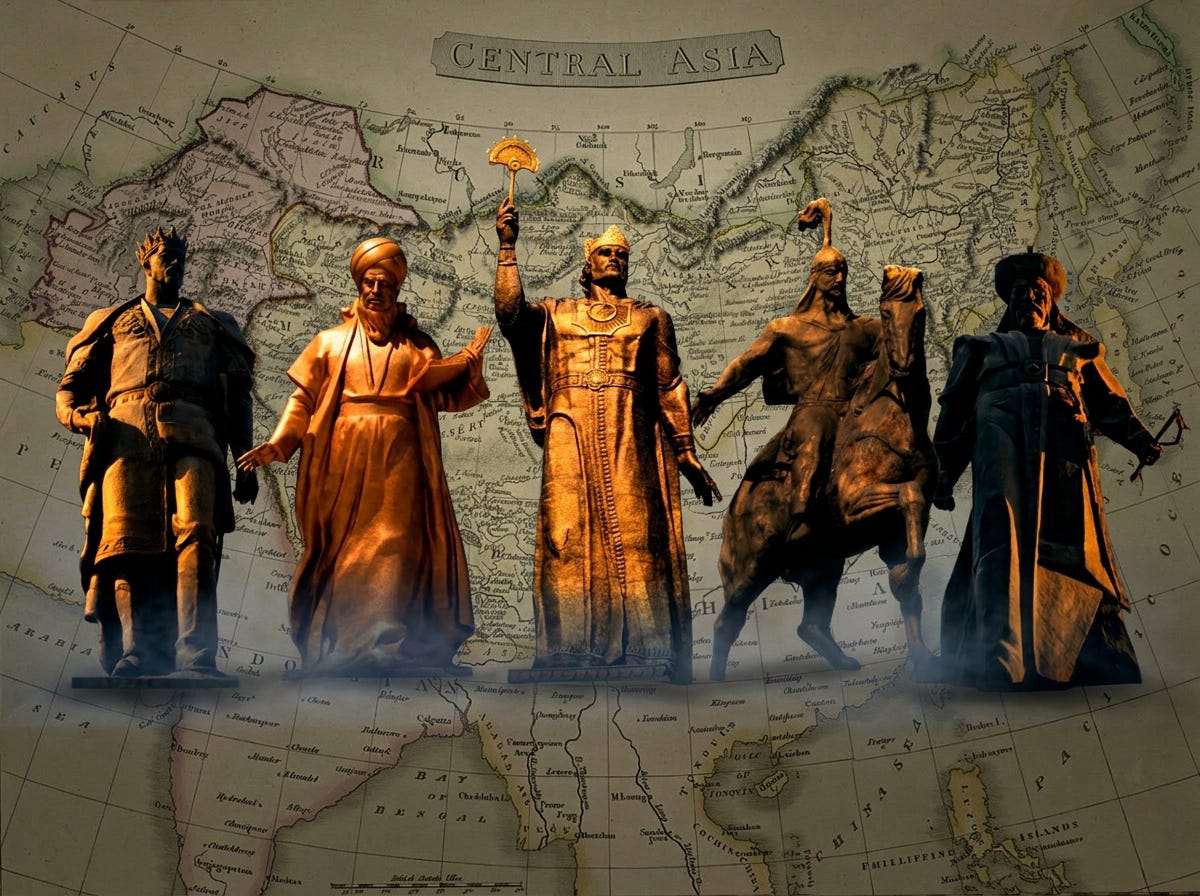
Central Asia: 5 Nations The World Forgot. Monday's Edition.
The five "stans" that may decide global power. Series 25 #1
Central Asia is a region of the world that Europeans are less familiar with and that Americans have generally never heard of. It’s an area that has been the concern of Russia, China, and the British Empire, when it was an empire.
Five nations sit south of Russia between China and the Caspian Sea. They hold a great deal of the world's critical minerals and natural gas, and almost nobody outside the region can name them:
Kazakhstan
Kyrgyzstan
American history books leave them out, and European textbooks include only a few lines because for two hundred years, Central Asia has been the purview of Russia, China, and the British Empire. Before Russia arrived, this region was the connecting artery of Eurasia. The Silk Road ran through Samarkand, Bukhara, and Tashkent. The cities were centers of mathematics, astronomy, medicine, and Islamic scholarship. The people were Turkic, Persian, and Mongol, organized into khanates and emirates.
The land was vast, and the cities were rich because everyone trading between China and Europe had to pass through. Different cultural perspectives, different languages, and different ways of organizing power lived side by side. Russia moved south in the 1800s. By the 1870s, Tsarist forces had taken the khanates one by one. The British, worried about pressure on India, watched and pushed back. The two empires shadowed each other across the mountains and deserts for the next forty years.
Rudyard Kipling called it the Great Game. The British eventually withdrew. Russia kept control. The Soviet Union absorbed the region in the 1920s and turned the region into Soviet states. Borders were drawn deliberately to cross ethnic lines. The intent was to make any future independence difficult to coordinate. Moscow ran the economy, the language, the schools, and the religion.
By 1991, when the Soviet Union dissolved, the five republics became countries overnight. Most kept their Soviet-era leaders, and Russia remained the dominant power. Russian was the working language. Russian banks moved the money. Russian troops trained the soldiers. Russian gas heated the cities. The five states were independent in name but all but Russian in fact. However, Russian influence has been waning since 2022.
The war in Ukraine showed Central Asia that Russia is weaker than it claimed. Russian troops left the region to fight and have not returned. Russian companies pulled cash home. Russian sanctions made Russian partners toxic to Western banks. The five governments did not condemn Moscow, but they stopped depending on it and supporting it. Kazakhstan refused to recognize the annexations of Ukrainian territory. Uzbekistan reopened conversations with Washington and Brussels. All five turned toward Beijing, which had been waiting for them.
China now buys most of the region's gas, builds most of its roads, and lends most of its development money. The European Union held its first Central Asia summit in 2025 and signed critical minerals deals. The United States is making an appearance, albeit inconsistently.
Each of these nations has different cultural perspectives, and that will determine how each reacts to Russia, China, and the West. Ignoring Central Asia is the biggest mistake most outsiders make. Treating it as one place is the second mistake they make.
Wednesday's edition examines how Russia is losing the region and why Moscow is not coming back.
Friday's edition examines what is replacing Russian influence: China, the big player, the European Union's late but serious entry, and where the United States fits, if it fits at all.
Saturday's Core Brief, for paid subscribers, looks at where each of the five states are liekly to be by 2030: deeper into Beijing's orbit, staying close to Moscow, or building working ties with Brussels or even Washington.
The cultural perspectives of each country drive the answer, and the answer is already visible in the policies being made now.
The region the world ignored for two hundred years is back.
If you enjoyed this article, help support my work by becoming a paid subscriber or “buy me a coffee.”


The cycling team "Astana" is from Kazakhstan. And who can forget Borat? And his famous sister, also from there ...
I lived in Uzbekistan for a couple of years and had the pleasure of doing business in each of the other "-stans" over the years, since 1990. Depending on the country and the political system, each has its own issues; however, each one is beautiful and the people are great to talk and socialize with. To a nation, there are many sects and tribes of Central Asian ethnicities. Just like in Italy, where someone is a Sicilian or Umbrian before they are Italian, so to are the sects and tribes of these countries. The Uzbek people, especially, are a broad mixture of Aryan, Chinese, Tibetian, Indian and Pakistani peoples -- many of whom are broad mixtures themselves -- primarily because Uzbekistan was the "Times Square" of the ancient Silk Road route. If you want a treat, head to Samarkand, one of the most beautiful cities in the world and take in the history there.