Assets and Liabilities - The Liabilities. Friday Edition
Which Nations Make The World Better? Series 15 #5
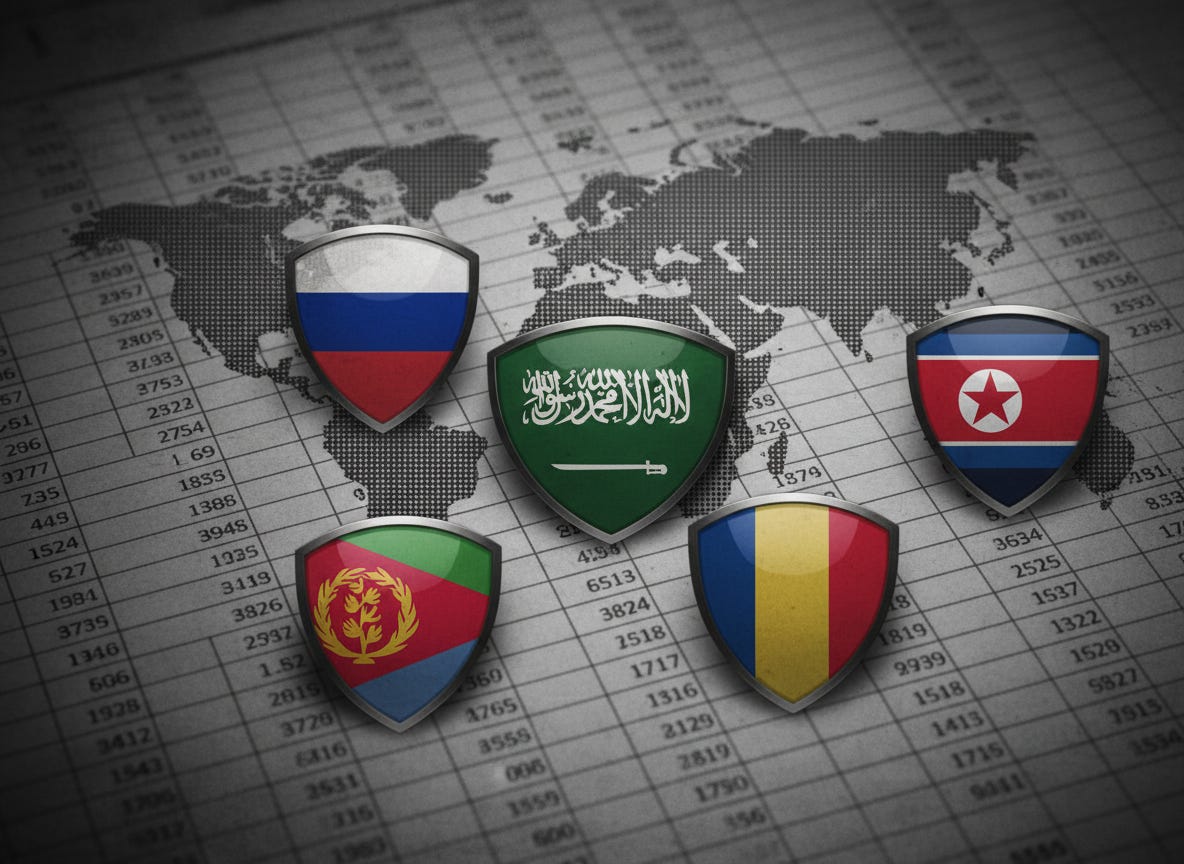
When Russia’s government poisons opposition leaders with radioactive polonium, it’s clear that power matters more than law. When Saudi Arabia executes 81 people in a day and bans women from driving until 2018, it enforces hierarchy through violence. When Eritrea conscripts citizens into indefinite military service, it treats people as state property. When Chad leaves 89% of its population without electricity, it has abandoned its people. When North Korea builds nuclear weapons while children starve, it aggrandizes the ruling elite over human life.
These are government choices. Five nations fail across environmental and human metrics through leadership driven by control rather than service, extraction rather than development, and maintaining power rather than improving lives, the liability nations of the world.
Hornby’s psychological archetypes reveal what separates these failures from success. Idea-driven nations focus on authority (high power distance), knowledge (long-term orientation, high uncertainty avoidance), or problem-solving. Feeling-driven nations operate from tradition (short-term orientation, high uncertainty avoidance), empathy (quality-of-life focus, collectivistic), or creative expression (low uncertainty avoidance, indulgent). Nations led by the power-seeking archetype leader, focused on control and dominance (high power distance, monochronic time) produce radically different outcomes than those run by the caregiver archetype, who prioritizes service.
Russia’s power-seeking leadership maintains control through repression and resource extraction. Saudi Arabia’s guardian archetype preserves extreme hierarchy and tradition while suppressing dissent. Chad’s failed governance allows power-seeking elites to control oil wealth while citizens suffer. Eritrea’s authoritarian guardian type imposes total state control. North Korea’s extreme power-seeking archetype subordinates everything, the environment, health, freedom, and development, to preserve the regime.
These nations share cultural characteristics: high power distance, accepting extreme inequality, a short-term orientation that focuses on immediate results over long-term development, and an internal direction that attempts to dominate and control rather than work with the situation.
Russia has a 72-year life expectancy, which is and has been declining since the Soviet collapse. Civil liberties score 7 out of 60 under Putin’s authoritarian rule. The government poisoned Alexander Litvinenko with polonium-210, Sergei Skripal with Novichok nerve agent, and Alexei Navalny in prison. Air pollution and inudstrial toxicns kills thousands annually in industrial cities. Oil and gas extraction funds military aggression rather than public services. High power distance governance concentrates wealth among oligarchs while ordinary Russians suffer and living standards decline.
Saudi Arabia burns massive amounts of oil, generating extremely high per capita emissions while maintaining authoritarian control (civil liberties ~7/60). Until 2018, women couldn’t drive and still had to have a male guardian's permission for major life decisions. The government executed 81 people in a single day in 2022, mostly for non-violent offenses. The average Saudi lives only 75-years despite oil wealth funding healthcare, the country fails to protect civil liberties completely. Short-term orientation extracts oil wealth for current consumption rather than building a diversified economy.
Chad’s citizens live a brief 53 years on average, three decades less than in wealthy nations. Literacy is noly 26%, and only 11% have electricity. Lake Chad has shrunk to 10% of its 1960s size from overuse and government neglect, destroying fishing and water supplies for millions. The Sahara Desert expands into Chad’s territory as vegetation disappears, and the government does nothing to stop desertification. Oil companies pump crude with no environmental regulations, no pollution controls, no protected areas, and no cleanup requirements. Oil revenues enrich ruling families, while citizens lack clean water, schools, and medical care. This isn’t resource scarcity, its power-seeking leaders who take oil money while citizens suffer. High power distance makes this exploitation normal to its people.
Eritrea operates as a totalitarian state, conscripting citizens into indefinite military service that functions as forced labor. The government controls all media, permits no dissent, and forces citizens to work on state projects for subsistence wages. Overgrazing and poor land management turned soil into dust. Severe drought and water scarcity leave most citizens without reliable water access. Civil liberties score near zero. Guardian archetype leadership imposes rigid order and tradition while ignoring the people and environmental destruction.
North Korea represents extreme power-seeking control. The government builds nuclear weapons and ballistic missiles while citizens die in famines. All information is state-controlled. Citizens worship the Kim family as divine. Life expectancy and literacy data are unreliable because the regime hides information. The few metrics available show malnutrition, stunted growth in children, and zero political freedom. Satellite images show mountains stripped bare where forests once stood. Citizens cut down trees for firewood and farming, leaving brown hillsides exposed. Without tree roots to hold soil, landslides bury villages, and floods wash away farmland. Soil erosion reduces crop yields. These environmental disasters worsen the famines that kill thousands. Citizens and the environment are irrelevant to the regime.
Geographic diversity shows failure isn’t limited to one region, and wealth doesn’t prevent failure. Russia and Saudi Arabia have resources, but produce terrible outcomes. And poverty doesn’t excuse failure; Chad’s oil revenues could fund development if the government chose to.
Failure follows patterns: leaders seeking power rather than serving the people, and short-term extraction ignores long-term development. Tomorrow, we examine what separates these patterns, whether culture, governance systems, or resources determine which nations make the world better versus worse.
If you enjoyed this article, help support my work by “buying me a coffee.”


