Assets and Liabilities - The Assets. Thursday's Edition
Which Nations Make The World Better? Series 15 #4
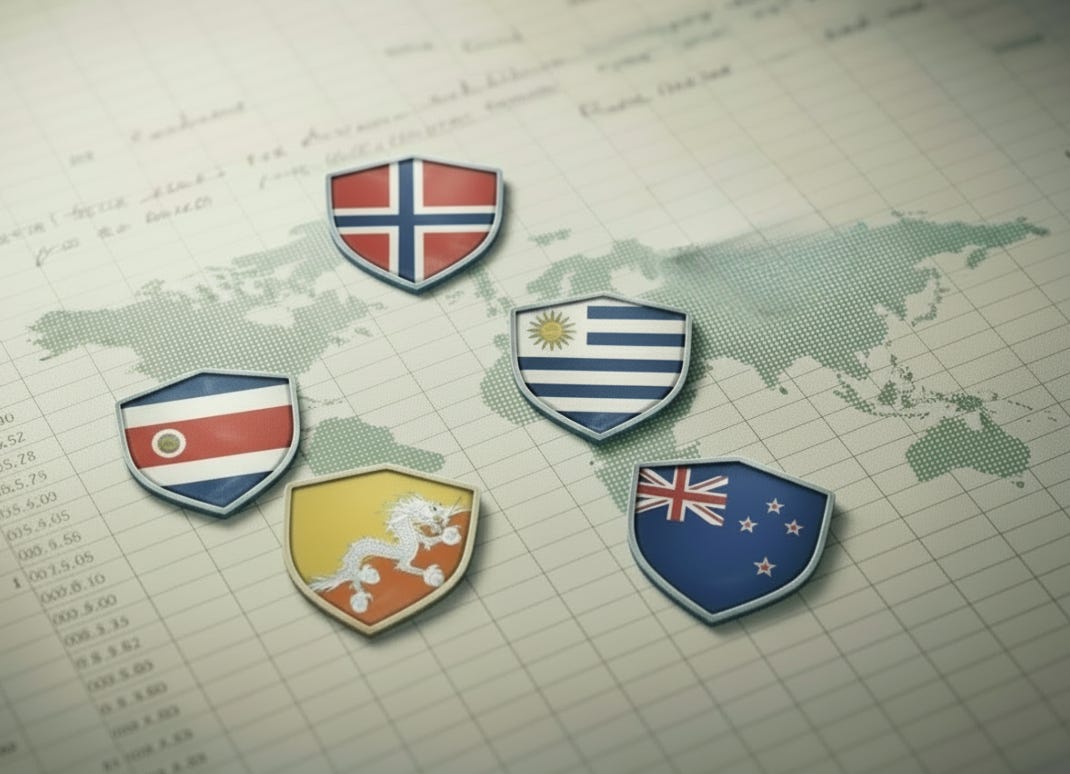
When Bhutan’s government measures success, it counts happiness, environmental protection, and cultural preservation along with GDP. When Costa Rica abolished its military in 1948, it redirected defense budgets to education and healthcare. When Uruguay legalized same-sex marriage in 2013, it extended civil rights while neighboring countries maintained discrimination. When New Zealand grants legal personhood to rivers, it acknowledges that ecosystems have rights beyond human extraction. When Norway builds a trillion-dollar sovereign wealth fund from oil revenues, it finances universal services instead of enriching a few elites.
These are purposeful actions taken by governments to improve the world. We look at five nations that excel across environmental and human metrics through leadership driven by service rather than dominance, evidence rather than ideology, and long-term wellbeing rather than short-term extraction.
The Leadership Pattern
Hornby’s psychological archetypes reveal what separates these asset nations from liability nations. Cultures that are more Idea-driven types focus on authority (high power distance), knowledge (long-term orientation and high uncertainty avoidance), or problem-solving. Feeling-driven types operate from tradition (short-term orientation and high uncertainty avoidance), empathy (quality-of-life focus and collectivistic), or creative expression (low uncertainty avoidance and indulgent). Nations led by caregiver archetypes, driven by empathy and service (quality-of-life focus, low power distance, high context), produce radically different outcomes than those run by power-seeking types focused on control and dominance (high power distance, monochronic time).
Costa Rica’s caregiver orientation explains why it abolished the military and invested in education. Norway’s combination of sage problem-solving and caregiver service created systems that convert resource wealth into universal healthcare rather than elite enrichment. Uruguay’s communicator leadership spreads evidence-based policies; legalized same-sex marriage, renewable energy, that solve problems rather than doing what is popular at the moment. Bhutan’s guardian archetype preserves tradition while adapting institutions to protect happiness and the environment. New Zealand’s caregiver-communicator blend extends empathy beyond humans to ecosystems.
These nations also share cultural characteristics. External direction toward nature, working with environmental constraints rather than dominating them. Low power distance governance expects equality rather than accepting hierarchy. Quality-of-life values prioritize caring over material achievement. Long-term orientation invests in future rewards over immediate consumption.
The Evidence
Norway runs 98% renewable electricity on hydropower, maintains 6 micrograms of PM2.5 air quality, and its citizens have an 83-year life expectancy with perfect civil liberties scores (60/60). Despite oil wealth creating CO2 emissions of 7.9 tons per capita, the country demonstrates that extracting resources can fund universal services when caregiver leadership directs wealth toward citizens rather than ruling families.
Costa Rica increased forest cover from 21% to 60% over four decades while running 100% renewable electricity. At 1.7 tons CO2 per capita, 81-year life expectancy, 98% literacy, and strong civil liberties (55-58/60), it outperforms far wealthier nations on most metrics. The country harnessed its rivers and volcanic heat for electricity instead of building coal plants. After abolishing its military in 1948, it spent defense budgets on schools and hospitals.
Uruguay generates 90%+ renewable electricity, achieves 79-year life expectancy, and 99% literacy with a strong democracy (civil liberties ~55/60). When Uruguay legalized same-sex marriage in 2013, it extended civil rights while neighboring countries maintained discrimination. The government built massive wind farms in the 2000s, transforming the country from an energy importer to a renewable leader. Policies serve the entire population, not just wealthy landowners or military generals.
Bhutan protects 51% of its land, runs largely on hydropower, and wrote into its constitution that 60% of its territory must remain forested. Life expectancy reaches 70 years and literacy 60%, behind wealthy nations but ahead of most Asian countries on civil liberties (near 40/60). The government measures Gross National Happiness: counting citizen wellbeing, environmental health, and cultural preservation alongside economic output, and makes policy decisions based on these metrics rather than GDP growth alone.
New Zealand gets 85% of its electricity from hydro dams, wind turbines, and geothermal plants. Life expectancy hits 82 years, literacy 99%, and civil liberties score 58 out of 60. One hundred percent of the population has safe drinking water and electricity.
In 2017, New Zealand’s parliament granted the Whanganui River the same legal status as a person. The river can sue polluters in court. Before the government approves a dam, mine, or factory near the river, it must consider whether the project harms the river’s health, the same way it would consider harm to human neighbors.
These five countries span Europe, Central and South America, Asia, and Oceania. Environmental protection and human development work in multiple cultures, not just wealthy Western democracies. But notice what’s missing. No Middle Eastern petrostate qualifies. No East Asian manufacturing powerhouse makes the list. No African nation yet achieved excellence across both environmental and human metrics.
Success follows a pattern: leaders who serve rather than dominate, governments accountable to all citizens rather than ruling elites, and long-term planning rather than short-term extraction. Tomorrow, we examine the liabilities, countries where power-seeking leaders, concentrated authority, and the drive for immediate profit destroy the environment and crush human wellbeing.
If you enjoyed this article, help support my work by “buying me a coffee.”


