Assets and Liabilities - Improving Lives. Wednesday Edition
Which Nations Make The World Better? Series 15 #3
In Norway, you turn on a tap and drink. The water arrives clean, tested, and safe, no boiling, no filters, no calculations about whether today’s supply carries dysentery. In Afghanistan, 57% of the population lacks safely managed drinking water. Women walk hours to wells contaminated by agricultural runoff and human waste. They boil water when fuel exists, risk illness when it doesn’t, and watch children develop chronic diarrhea that stunts growth and cognitive development. Water access is more than infrastructure policy; it determines whether kids reach their fifth birthday.
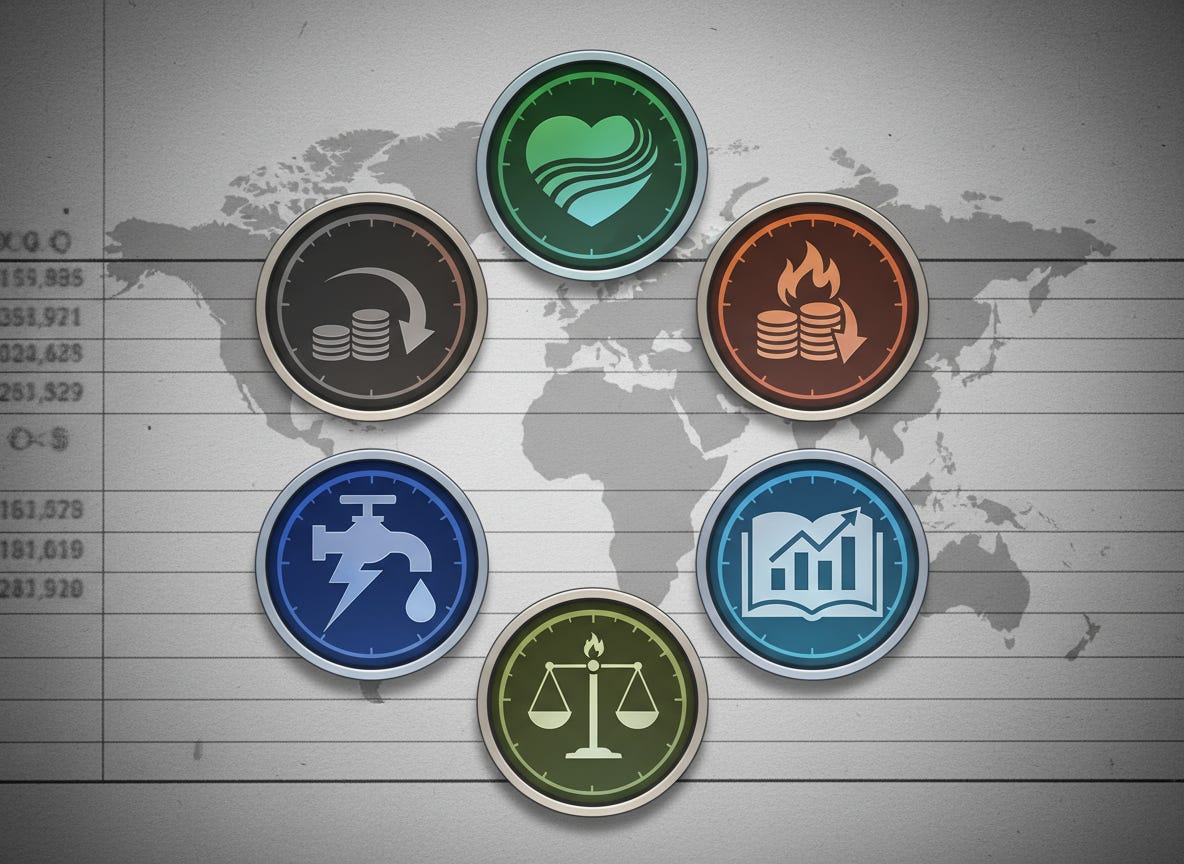
Six human metrics reveal whether nations actually improve lives: life expectancy, poverty rates, literacy, civil liberties, water access, and electricity. These are measurable, concrete outcomes that determine whether people live long, healthy lives, escape destitution, read, exercise freedoms, and access basic services, or live a much lower quality of life
Material Foundation
Extreme poverty, living on less than $3 per day, traps 60-70% of Afghanistan’s population. They can’t afford adequate food, shelter, healthcare, or education. Norway’s poverty rate is below 1%. Costa Rica’s is 3-5%, despite one-fifth of Norway’s per capita income. The United States manages 1-2%, though this masks enormous inequality in a country where medical bankruptcy exists alongside billionaire space tourism.
These gaps reflect cultural values. Quality-of-life-focused cultures prioritize caring for those needing assistance and social safety nets over material achievement. Achievement-focused cultures celebrate individual success and accept poverty as motivation for personal effort. Costa Rica’s quality-of-life orientation drives universal healthcare and education despite limited resources. America’s achievement orientation blames the poor for poverty and worships the extremely wealthy.
Water access exposes government priorities. Norway, Costa Rica, and Greece provide safe drinking water to 99-100% of their people. Afghanistan reaches 43%. This isn’t about wealth. India provides safe water to 63% of its population despite a lower per capita income than many countries performing worse. Sri Lanka reaches 65%, Indonesia 71%. The gap separates nations treating water as a universal right from those accepting mass deprivation as normal.
Universalist cultures apply rules and services equally to all citizens. Particularist cultures adapt rules based on relationships and circumstances. Universal water provision requires universalist values; everyone deserves clean water regardless of wealth, ethnicity, or political connections. Particularist systems deliver water to favored groups while others remain unserved.
Electricity access tells a similar story. Norway, Costa Rica, and the United States reach 100%. Afghanistan provides electricity to 84%, better than its water access, but still leaving 16% in darkness. Chad reaches 11%, Burundi 12%, South Sudan 8%. Without electricity, refrigeration is difficult, medical equipment is unusable, education after dark becomes impossible, and economic productivity collapses. These aren’t minor inconveniences, they’re development death sentences.
Human Development
Life expectancy measures whether healthcare, nutrition, and safety allow people to live full lives. Citizens in Japan and Hong Kong live to an average of 84 years. Norway hits 83. The United States reaches only 78.8 years despite being the richest nation and spending more on healthcare per capita than any other nation. Americans die younger than Costa Ricans while paying five times more for medical care. Afghanistan’s life expectancy sits at 62-64 years, robbed of two decades by conflict, malnutrition, collapsing healthcare, and maternal mortality rates among the world’s highest.
Low power distance cultures expect equality, demand that the government serve all citizens rather than just elites. This drives universal healthcare systems that extend life expectancy across entire populations. High power distance cultures accept hierarchy as natural, tolerate healthcare systems serving the wealthy while the poor die from preventable diseases.
Adult literacy separates opportunity from permanent exclusion. In Costa Rica 98% of the people are literate, Norway exceeds 99% as does the United States. Afghanistan manages 43%. This means 57% of adults cannot read contracts, healthcare instructions, election ballots, or job applications. In Chad, only 26% of the population can read or write. When most adults can’t read, democracy becomes theater, economic mobility is impossible, and dependence becomes generational.
Civil liberties measure whether people actually control their lives. Norway scores 60 out of 60 on Freedom House’s scale, perfect marks for expression, assembly, rule of law, and personal autonomy. Costa Rica scores 55-58, maintaining a strong democracy despite regional instability. The United States scores 51, and is falling as voting restrictions increase and courts take away rights. Afghanistan under Taliban rule scores 1-3 on freedom of expression, assembly, or personal choice, especially for women barred from education and employment.
These six metrics create accountability. Countries either extend lives through healthcare or they don’t, eliminate poverty or accept mass destitution, teach people to read or condemn them to illiteracy, protect freedoms or crush them, and provide water and electricity or leave millions without. The measurements expose whether nations are assets to the world and improve lives or are liabilities to the world.
Tomorrow, we examine nations that are clear assets for the world. Countries excelling on both environmental and human metrics, and what policy choices separate genuine progress from lip service.
If you enjoyed this article, help support my work by “buying me a coffee.”


