Why Countries Stay Free: 60 Years of Data. Monday’s Edition.
Why some countries become democracies and others do not. Series 26 #1.
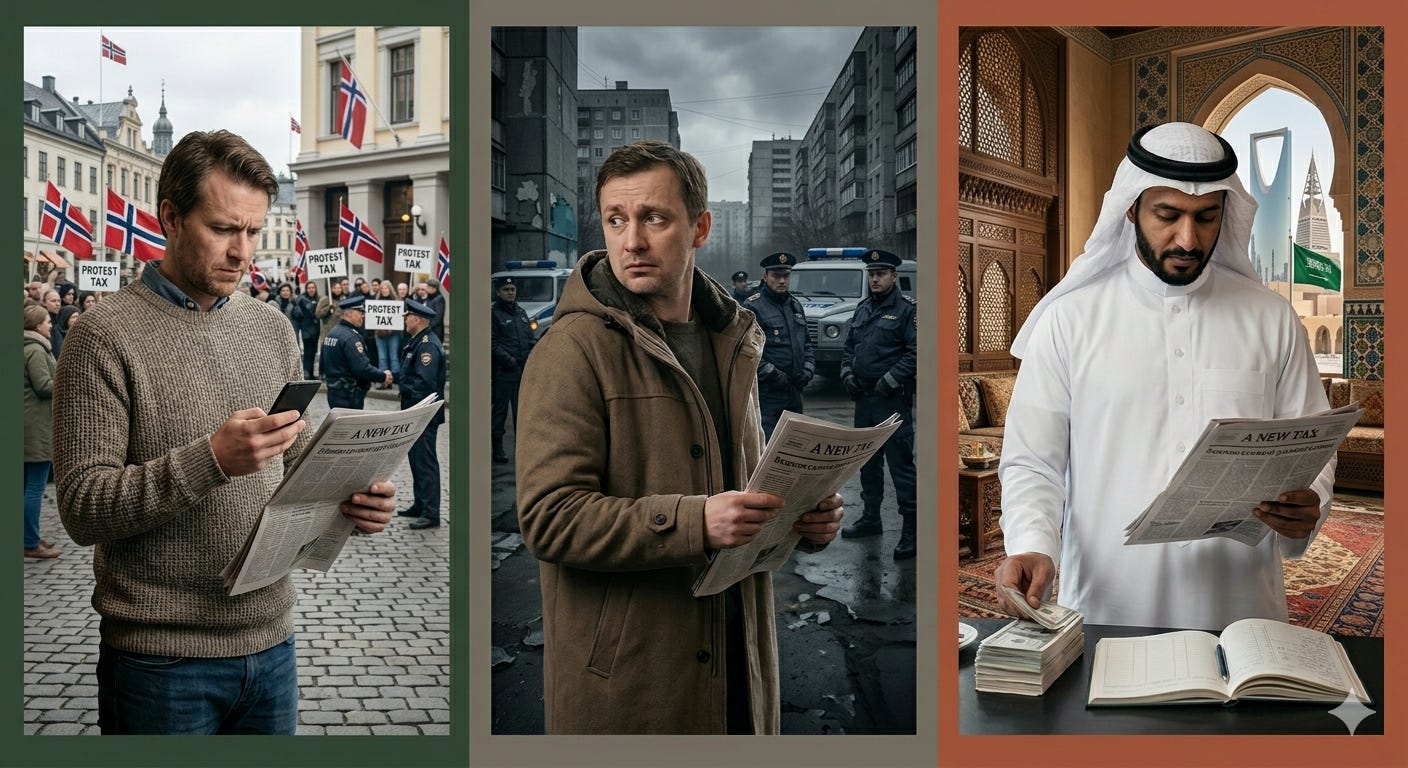
A Norwegian, a Russian, and a Saudi read about a new tax. They may have even walked into a bar.
The Norwegian ask the question, “How do I get this law changed?” He writes to his representative, posts his opinion online, and joins a protest. Nothing happens to him. His name does not go on a list. His boss does not call him in. He does not like the tax; he takes action.
The Russian does not ask the question. If he posts publicly, he may lose his job or face a fine. If the post spreads, he may face charges. There are no protests to join. He knows people who said something and had to flee the country. He does not like the tax: he does nothing.
The Saudi does not think of asking the question. The thought does not arrive. The king’s decree is the king’s decree. He neither likes nor dislikes the tax: he works out how to pay it.
Political scientists have spent decades asking why some countries become stable democracies, and others become authoritarian. The standard answers are economic (rich countries become democratic), historical (countries with British colonial legacies become democratic), and institutional (countries with strong courts become democratic). All three are partly right and partly wrong. Rich Singapore is not a democracy. Poor India is. South Korea was a dictatorship in 1985 and a working democracy in 1995. Belarus, Turkmenistan, and Tajikistan adopted democratic constitutions in the 1990s, but in practice, they are personalist autocracies.
There is a fourth explanation, less discussed but more developed: Culture. Specifically, the cultural perspectives a population holds about hierarchy, equality, the individual, and authority. These perspectives shape what people will accept from their government and what they will push back on.
Four researchers, working separately over six decades, mapped the cultural perspectives that separate democracies from authoritarian states. Their names are Geert Hofstede, Shalom Schwartz, Fons Trompenaars, and Ronald Inglehart & Christian Welzel. Each used different methods, frameworks, and vocabularies. Each measured tens of thousands of people across dozens of countries.
Geert Hofstede was a Dutch social psychologist who developed the framework based on IBM employee surveys conducted across more than 50 countries in the 1960s and 1970s. His IBM dataset gave him an unusually clean cross-cultural comparison: the same company, the same job titles, in different countries.
Shalom Schwartz is an Israeli social psychologist. He developed his framework in the 1990s, surveying teachers and university students in more than 70 countries. He chose teachers because they transmit mainstream cultural values to the next generation. He frames culture as the way individuals relate to the group, how social behavior is controlled, and how people relate to the natural world.
Fons Trompenaars is a Dutch organizational theorist. His framework was built from tens of thousands of managers across more than 40 countries beginning in the 1980s and was first published in 1993. He frames culture as the way a group solves dilemmas.
Ronald Inglehart was an American political scientist, and Christian Welzel is a German political scientist. They built the World Values Survey beginning in 1981 across nearly 100 countries. The survey was designed to measure values relevant to democratic politics.
Do cultural perspectives correlate with democracy? Yes. But the pattern only becomes clear when you understand how the frameworks work together.
Wednesday’s edition examines Hofstede and Schwartz. Power Distance, Individualism, Autonomy, and Egalitarianism. What these dimensions measure, how they were built, and what they say about who accepts hierarchy and who refuses it.
Friday’s edition examines Trompenaars and Inglehart-Welzel. Universalism, Achievement, Internal Control, secular-rational values, and self-expression values. Why the Inglehart-Welzel map separates democracies from authoritarian states more cleanly than any other tool in the social sciences.
Saturday’s Core Brief, for paid subscribers, shows the single cultural pattern they all describe, in two parts. It is the answer to the week’s question.
Cultural perspectives set the foundation for the type of government. Institutions are built on that foundation. When the foundation cannot support the weight, the building falls.
If you enjoyed this article, help support my work by becoming a paid subscriber or “buy me a coffee.”


